
Internal rate of return (IRR)

What is the internal rate of return?
The internal rate of return or profitability (IRR) is an indicator that represents the interest rate of an investment project. By facilitating the comparison with the interest rates of similar projects, this allows to evaluate the convenience or viability of placing funds in a certain investment.
The internal rate of return rule is to accept an investment project if the cost or rate of investing in another project is less than the IRR.
How is the internal rate of return calculated?
The internal rate of return is defined as the discount rate at which the NPV (net present value) equals 0.
In other words, to know the IRR, you have to know the NPV formula and solve for the IRR. Thus, we have to:
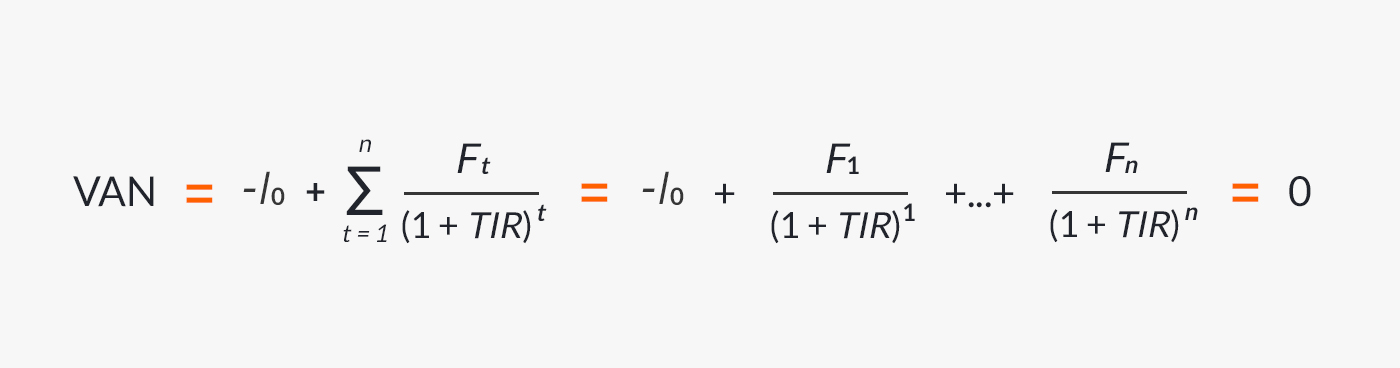
Formula to calculate the internal rate of return.
While most use a computer or programmed calculator to find the IRR value, manually follow the trial and error method: different values are tested for the IRR until the NPV is equal to zero.
Internal rate of return example
Suppose an investment project generates the following flows:
- I₀ = - 6,000 (initial investment).
- F₁ = 3,000.
- F₂ = 6,000.
The formula would be:
- VAN = - 6,000 + 3,000 / (1 + IRR) ¹ + 6,000 / (1 + IRR) ² = 0.
Testing with an arbitrary discount rate of 0, we have:
- VAN = - 6,000 + 3,000 / (1.0) ¹ + 6,000 / (1.0) ² = + $ 3,000.
The net present value is positive; therefore the IRR must be positive. We then apply a new discount rate of 50%. Remember that we are looking for the IRR that makes NPV = 0. Thus:
- VAN = - 6,000 + 3,000 / (1.50) ¹ + 6,000 / (1.50) ² = - $ 1,334.
The result is negative, so the IRR must be less than 50%.
A simple way to calculate the IRR is to graph 3 or 4 combinations of NPV with the IRR, connecting the dots and finding the discount rate at which the NPV = 0.

Internal rate of return / net present value graph.
Thus, the IRR that makes the NPV = 0 is 28.07%.
If the opportunity cost of capital is less than 28.07%, that is, the expected rate of other assets with the same level of risk is lower than the IRR, then the project has a positive NPV when discounted at the opportunity cost , so it is convenient to make the investment.
Suppose that the opportunity cost is 26% (lower than the IRR of 28.07%):
- VAN = - 6,000 + 3,000 / (1 + R) ¹ + 6,000 / (1 + R) ² = 0, where R is the opportunity cost of capital.
- VAN = - 6,000 + 3,000 / (1.26) ¹ + 6,000 / (1.26) ² = $ 279.29
| Bibliography: |
|---|
|
Leave a Reply