
Discount rate

What is the discount rate?
The discount rate, also known as discount rate or cost of capital, is a financial factor that is used to calculate the present value of a future payment.
In this way, it serves to verify the feasibility of an investment project, since from the moment it manages to determine the value that the money that will be received in the future has today, it determines whether an investment will be convenient or not.
The more an investor is quick to get his money back, the less value it will have in the present. This occurs by not assuming the risk that involves the uncertainty of what may happen later, such as unexpected situations that prevent you from receiving payment in a timely manner from your debtor.
This is the reason for the generally positive nature of the discount rate: the value of money in the future will have a higher value than it is in the present. However, in exceptional cases the discount rate can be negative: in this case, the present value of money is greater than the future value of money.
Discount rate allows determining the NPV (Net Present Value) of an investment project, with which its profitability is determined. It is also used to know the IRR (Internal Rate of Return), that is, the discount that equals the Net Present Value to zero (NPV = 0); Although they are not the only uses of the discount rate, they are the most common.
The discount rate is made up of the following aspects:
- Capital cost: same that incurs in a company in order to finance investments. It is of utmost importance when calculating the value of this very entity.
- Opportunity cost: applied to a resource when it is used in a specific way. It is also understood as an unrealized investment. It is a cost that is directly linked to the action of an agent in not making a choice.
- Cost of debt: is the breakdown of expenses of a company when carrying out financing, credit and loan procedures.
How is the discount rate calculated?
The way to calculate the discount rate is simple, only the following formula should be applied:
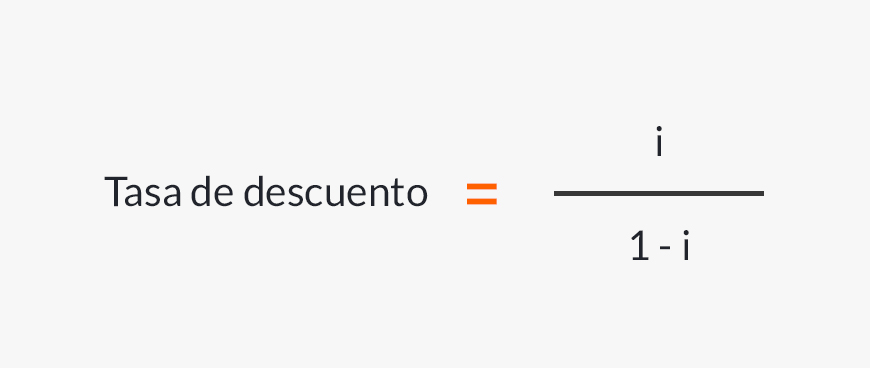
Formula to calculate the discount rate.
Where:
Many times the discount rate set by the Central Bank is taken as a reference and discount rates are also used from similar investments.
Discount rate example
Suppose that an investor invests 1,000 pesos today, of which he will receive 300 pesos every December 31 for 4 years. At first glance, this seems to be a profitable investment, since you will receive a total of 1,200 pesos, but this will only be known for sure after determining the current value of those 1,200 pesos.
So, the first thing to do is calculate the NPV of each period, like this:
- GO 1: 270 pesos (present value of the 300 pesos that will be received on December 31 of year 1).
- GO 2: 250 pesos (present value of the 300 pesos that will be received on December 31 of year 2).
- GO 3: 230 pesos (present value of the 300 pesos that will be received on December 31 of year 3).
- GO 4: 210 pesos (present value of the 300 pesos that will be received on December 31 of year 4).
From here it is observed that:
- The more time passes, the less value money has today.
- The sum of the NPV of the 4 years is 960 pesos, that is to say that this is the current value of the 1,200 pesos that the saver will receive in 4 years.
- At first the investment looked very profitable, however the reality is different, since the current value of the 1,200 pesos is 960 pesos.
| Bibliography: |
|---|
|
Leave a Reply