
Opportunity cost

What is the opportunity cost?
The opportunity cost is andThe alternative cost that is waived when a particular decision is made. This includes the benefits that could have been obtained if the other option had been chosen.
In other words, the opportunity cost comprises those resources that a person gives up when making a choice or making a decision.
This concept is also known as the value of the best option not selected.
Opportunity cost types
The opportunity cost can be increasing or constant.
Growing
Also called law of increasing opportunity cost, this type of cost shows how such as some extra units of a certain product are made, their opportunity cost will be in relation to said production.
Understanding this concept helps companies decide whether increasing production is a good choice or not. In this way, it will be easier to achieve an action plan that provides fewer losses and more benefits.
Constant
This type of cost refers to the costs that are related to the production of a certain service or product that remain stable, allowing production levels to be higher.
In this mode, the relationship between costs and the number of products will be forever the same.
Steps to calculate opportunity cost
To calculate the opportunity cost, the following steps must be performed:
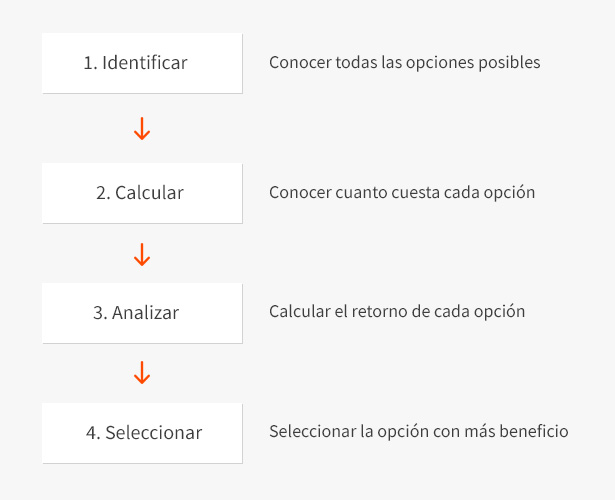
- Identify the alternatives available: be aware of all the options and alternatives that allow you to obtain certain benefits.
- Calculate the expenses of each alternative: know how much each of the available options costs, that is, what will be the expenses, costs and resources that will be needed to start the project.
- Calculate return on investment: know what benefits each option and investment alternative will provide.
- Choose the most profitable option: the option that is most beneficial and most profitable should be chosen.
Opportunity cost examples
Here are some examples to better understand this concept:
A person decides to invest his saved money. A certain bank proposes a fixed term that will have a 16% interest rate, but on the other hand, a private entity suggests that Invest in bonds that will earn you 13% interest.
The person makes the decision to invest their savings in a fixed term, so that the opportunity cost will be 13% of earnings that the bonds would have provided him, which he ended up giving up when he chose the fixed term.
Likewise, a person has a house that they do not live in and that does not have taxes, they have two alternatives: rent it for $ 5000 per month or not rent it. The opportunity cost of not renting the house would be represented by $ 5000 per month.
Leave a Reply