
haulage
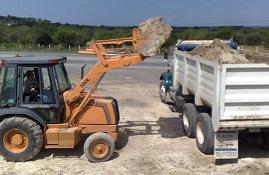
The first thing we have to establish is the etymological origin of the term carry that we are now dealing with. In this sense, we can say that it derives from Latin, specifically, from the noun “carrus”, which can be translated as “vehicle with wheels”.
The notion of haulage it can be used in a number of ways. The first meaning mentioned by the Royal Spanish Academy (RAE) in his dictionary refers to act of hauling: move something, cause damage.
For example: "I had to pay a thousand pesos for the transport of my car to the mechanic shop", "The transportation of soybeans will be suspended for a week due to a protest by transporters", "The government still has to define how it will carry the gigantic statue from the port to the square".
In this sense, we can determine that it is a very important word in terms of the transport of goods in ports. Why? Because it is established that in order for the ships to be able to start up with the loads they have to carry, it is necessary to have an important network of various transports that take care of the hauling.
In other words, there must be vehicles and companies specialized in the transport of these goods so that they can arrive at the dock well in advance and thus be able to enter the boat. In the same way, it is essential that they are also in charge of carrying those loads from the ships to their land destinations so that they can continue their journeys without any delay.
The usual thing in this second possibility is that trucks and vans, for example, are dedicated to taking the goods from the ship in question to warehouses and then, in the next few hours or days, proceed to distribute them to their recipients. Therefore, it is a question of having a solid logistics network that, with exhaustive control, proceeds to transport mainly those loads by road to the recipients, which can be from stores to various industries.
The idea haulage is also used in the field of geology. In this case, the term is used as a synonym for moraine (the accumulation of mud and rocks that makes a glacier) or scree (the earth covered with stones).
Carriage is also present in the math, more precisely in arithmetic. It is, in this case, a resource that is used in the sum to "to transfer" a digit while performing a calculation.
Suppose we want to solve the following operation: 57 + 36. To perform the calculation, we can order the digits in columns.
57
+
36
Thus, we first add the digits of the column lower power: 7 + 6. In this case, the result is 13. Therefore, we place the 3 as a result of that first operation and "We get along" the 1, which goes to the other column. The 1, therefore, is the haulage. Then, in this second column, we add 5 + 3 and we add the 1 carry: the result of this sum is 9. Thus we then obtain the final result of the operation: 57 + 36 = 93.
Leave a Reply