
Net present value (NPV)

What is net present value?
The net present value of an investment project (GO) it's a investment selection criteria. This represents the present value of net cash flows (income minus periodic expenses) present value of net cash flows (income minus periodic expenses) that the investment can generate in a certain time.
If the NPV is greater than zero, that is, positive, the project is said to create wealth for investors.
To find the net present value, you have to discount your future cash flows at an acceptable discount rate, also known as the cost of capital; that is, the standard rate of return of other assets with similar risk or that set by the Central Bank. For example, if future cash flow is safe, then the discount rate that can be taken as a reference is the interest rate on risk-free debt securities (for example, government bonds of a country).
According to financial experts, cash flows are discounted for 2 reasons:
- Because a dollar today is worth more than a dollar tomorrow (you can reinvest today to start receiving interest immediately).
- Because a safe dollar is worth more than a risky one.
How to calculate the net present value?
The formula to calculate NPV is as follows:
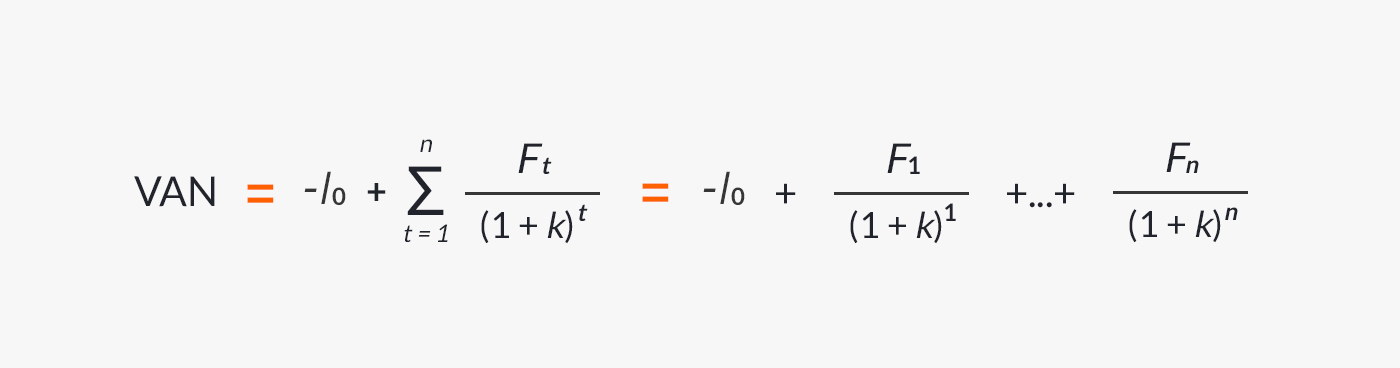
Formula to calculate NPV (net present value).
Where:
- I₀: initial investment.
- Fₜ: net cash flows.
- Fₙ: net cash flows for period "n".
- k: discount rate or cost of capital.
Based on the results obtained through this formula, we can deduce that:
- If he VAN is greater than 0, the project will generate benefits for the investor.
- If he VAN equals 0, will report neither profit nor loss.
- If he NPV is less than 0 the project will not generate a profit, so it should not be invested in it.
Difference between NPV and IRR
Although both the net present value (NPV) and the internal rate of return (IRR) help analyze the viability of an investment project, they do it differently:
- Profitability of a project: NPV determines the profitability of a project based on net cash flows (monetary units). If the NPV> $ 0, it will be recommended to invest in the project. The IRR, however, uses rate differences in its criteria, so that if the cost of capital is less than the IRR, the investment will be viable.
- Cash flows: NPV assumes that cash flows will be reinvested at the same discount rate. The IRR criterion considers that the cash flows will not be re-invested at the discount rate, but based on a% return, therefore it overestimates the investment capacity of the project.
- Different results: If an investment project has positive and subsequently negative cash flows (for example: loan), the NPV can increase as the discount rate increases. This project should be accepted if its IRR is less than the cost of capital. Contrary to what happens in simple projects, which have a negative outlay (initial investment) and then positive cash flows.
Example of net present value
Let us suppose that the company «Alimentos SA» has decided to build a second production plant, given the increase in sales in recent months. To do this, it has calculated the following annual cash flows:
- I₀ = - 15,000 (initial investment)
- F₁ = 3,000
- F₂ = 6,000
- F₃ = 7,500
- F₄ = 9,750
- k = 12% (cost of capital of similar investments)
Replacing the values in the formula, we have:
- GO = - 15,000 + 3,000 / (1 + 0.12) ¹ + 6,000 / (1 + 0.12) ² + 7,500 (1 + 0.12) ³ + 9,750 / (1 + 0.12) ⁴ = $ 3,996.56
As the NPV is greater than 0, it is concluded that the construction of a new plant is convenient and profitable.
| Bibliography: |
|---|
|
Leave a Reply