
Capitalism

What is capitalism?
Capitalism is a economic system that defends the freedom of the market and that the means of production are privately owned.
In this way, it uses the market as a mechanism to efficiently use resources and have a capital that generates more income.
As a result, it is possible to affirm that the capitalism is the opposite of socialismIt is based on the fact that productive resources and industries belong to individuals and not to government organizations.
Characteristics of capitalism
The main characteristics of capitalism are the following:
- It is governed by market freedom, In other words, it uses free trade to manufacture, buy and sell any type of goods and services, especially those most in demand by society.
- Owns a minimal government intervention and oversight, since government entities manage national defense, so that private property is respected and all contracts are fulfilled, but they only intervene as regulatory bodies.
- Since mostly private properties are developed, capitalism earns the respect of the industry.
- Has free stipulation of prices so that resources and their distribution among individuals is freely assigned.
- Presents complete freedom in terms of hiring, legality and the financial resources that can be obtained.
- Promote the entrepreneurial spirit.
- Chase the economic growth.
Types of capitalism
It is possible to classify capitalism as follows:
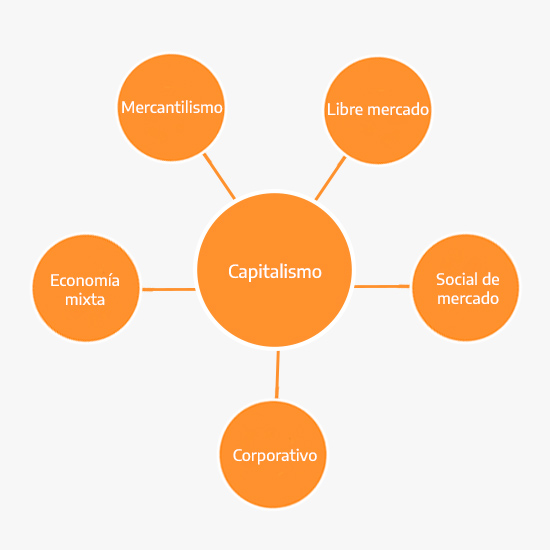
The main types of capitalism.
Mercantilism
Mercantilism is a doctrine that was born in Europe between the 16th and 18th centuries, and that argues that countries will be more prosperous and successful the more wealth they accumulate. In this way, they must maintain a positive trade balance, where exports exceed imports.
Free market
This system of capitalism, also called a market economy, is characterized by set the prices of goods and services through supply and demand. In this way, avoid the intervention of the State or any third party.
Social market economy
The social market economy supports a minimal government intervention in the economy, but ensures that basic and important services, such as social security, labor rights or education, are under the command of the State or under agreements where it intervenes.
In the social market economy, the vast majority of companies are privately owned and owned. This is often the most widely used form of capitalism today.
Corporate capitalism
This type of capitalism, bureaucratic and hierarchical, holds that the public sector (State) only intervenes in the market to benefit and promote the interests of corporations.
Thus, in corporate capitalism, the state is in charge of remove competitive barriers and provide subsidies to companies to boost the country's economy.
Mixed economy
The mixed economy it combines public sector intervention with the supply and demand market.
This type of capitalism has a greater intervention of the State, since it ensures that the population has the right to necessary supply of resources. The mixed economy is also a widely used system today.
Origin of capitalism
Capitalism or «andfree economy » It has been around since the earliest civilizations. However, appeared in Europe in the thirteenth century, when introduced as a substitute for feudalism, the social economic system of the Middle Ages.
Before capitalism existed as an economic system, work was practically mandatory and was required as slavery, servitude and a socio-moral obligation. In this way, capitalism proposed that work be done for wages and that workers be considered as employees, not as slaves.
Capitalism and socialism are completely different economic systems.
Capitalism develops production with private entities and non-governmental, while socialism defends economic equality and helps the government eliminate inequality in society, implementing programs that protect those who have the least in an economic sense.
Definitely, capitalism is sustained through the freedom of the market while, in contrast, socialism supports a greater and rigorous state intervention in the market.
On the other hand, capitalism is governed by work independently for incomeTherefore, as the main ideal, the one who works less will have less, and the one who works more will have more.
Examples of capitalist countries
Some countries employing the capitalist system at present they are the following:
| Japan | USA |
| France | Italy |
| Germany | Holland |
| Sweden | Belgium |
| England | South Africa |
Leave a Reply