
random
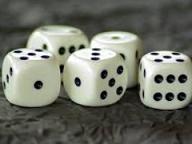
The etymology of random refers us to azzahr, a word from Hispanic Arabic. The concept is used with reference to the lucky, the fortune wave chance. For example: "Chance was on our side and the draw favored us", "This is a game of chance where the ability of the participant does not influence", "Everything I have achieved in life was thanks to effort: there are no achievements by chance".
The last example serves to expose the negative nature that chance has for some people, if they see a lack of commitment or action in the life. On the other hand, many believe that success depends to some degree on luck, which must be combined with due effort, so that neither extreme is ideal.
It is known as gaming to the entertainment in which to achieve a victory or suffer a defeat depend on fortuitous circumstances that exceed the player's ability. This means that there is no tactic that enhances the chances of victory, since it is linked to luck.
The gambling they are the typical example of games of chance. In these cases, the result is related to statistical probabilities that a certain number or a combination will be drawn. One person can bet 100 dollars on the roulette to the number 2. 3: chance will determine whether or not that number comes out. The player has no chance of influencing this result, and this often leads to frustration that can lead to a vice; If it were a technical discipline, failure could lead to a greater commitment to training to improve results.
In others games, chance is combined with the ability of the individual. That is the case of trick, a very popular card game in South America and in certain regions of Spain. Chance determines which cards (cards) the player receives in each hand; then, it is the player who must use his ability to prevail against his rival.

The concept of chance is analyzed in various sciences and disciplines. It is usually associated with the idea of randomness: that whose result cannot be predicted. In other words, the outcome of a random process cannot be determined before it occurs because chance is involved. Through the statisticsHowever, it is possible to anticipate the probabilities of obtaining a certain result.
In the field of computer programming, chance plays a very important role in getting programs to behave with a certain degree of spontaneity. The human being does not know the true nature of the events that he considers random: just as we cannot affirm with total conviction how the universe originated and - much more precisely - our own existence, we do not know if there really are unpredictable events or if it is our own perception that we consider them that way.
Given this lack of understanding of the randomness of nature, it is logical that we are not able to reproduce it through technology either. In this way, the processors are able to throw values that simulate chance, even if they do so by a completely different and - needless to say - artificial path.
Chance in programming has a great number Of applications. In a video game, for example, we can use it so that a different number of enemies appear in each game, and that they are not always of the same class. In a rain simulation, on the other hand, we can achieve that the drops always have different sizes and orientations, and that the density of the clouds and the intensity of the wind also vary in each execution.
Leave a Reply