
contemporary art

To define this concept we must clarify in advance the meaning of the terms that comprise it: art and contemporary.
Art is a term that comes from a Latin word that refers to the creations of the man to express your sensitive vision of the real or imaginary world through the use of plastic, sound or linguistic resources.
Contemporary It is a word that refers to that which belongs to or is related to the time in which one lives. Those who lived in the second half of century XVIII, for example, were contemporaries of Wolfgang Amadeus Mozart, not so those who were born in the twentieth century.
After this parenthesis we proceed to define the unified concept. is defined as contemporary art to all artistic works produced in our epoch. Of course, this definition will depend on who pronounces it. The art produced in the XIV century it was the contemporary art of the people who lived in the year 1300.
The contemporary, however, can be understood in different ways. For some specialists, contemporary art is that which arose in the story immediate (in recent decades). For other experts, contemporary art is understood as that developed from the Second World War ([1945). A broader version of the notion extends contemporary art throughout the world. twentieth century and, there are even those who believe that contemporary art is the one that emerged in the Contemporary age (which starts at the end of century XVIII). This means that, depending on who uses the concept, there are certain variants that can appear around the date that is being talked about.
But surely the most generalized definition refers to contemporary art such as that produced in the last century. We will thus find very diverse currents and styles that coexist; such as the expressionism, the cubism, the Dadaism, the surrealism, the pop-art and the conceptual art, with references like Henri Matisse, Pablo Picasso, Piet mondrian, Marcel Duchamp, Salvador Dali Y Joan Miro.
Contemporary Art: Before and After
We must clarify, however, that these trends that emerged in the twentieth century were the result of the trends carried over from the nineteenth century. In fact, these new types of expression, Impressionism and Post-Impressionism, are considered as starting points. From which arose the most outstanding avant-gardes of the following century: Fauvism, Futurism, Expressionism, Dadaism, Cubism, Constructivism, Surrealism and Neoplasticism.
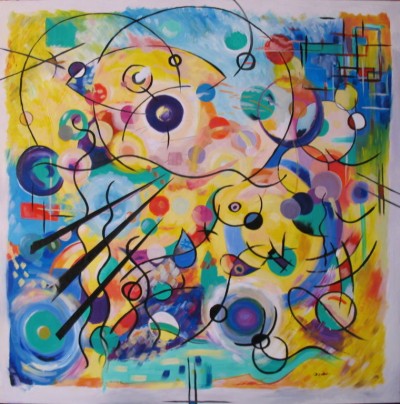
At this point it must be said that among all these currents there are common elements in terms of the ideology; in that desire to innovate and to give art a different space from the one it had had until then. However, it differs in the aesthetic purposes that each trend pursued.
Contemporary art characterized by denying the past and seeking a way to expression to break with everything raised so far, They no longer dedicate themselves to imitating the great references of art, but to creating new forms, to interpret starting from a virgin space where color and form acquired powerful qualities.
What we can say is that although it is important to point out that things were not that way because you cannot create something absolutely detached from the known: we build based on what we already know, we correct, we remake, always from the known.
These aesthetic currents emerged before the Second World War and, after it, there was a new resurgence of contemporary art, led by new currents among which the collecting, thanks to which art becomes a work for speculation. Abstract Expressionism is also located at this time, which would close with the currents linked to Modernism. In the middle of the century there is a new change in society that will be reflected in a new way of creating, Postmodernity.
Leave a Reply