
Chess
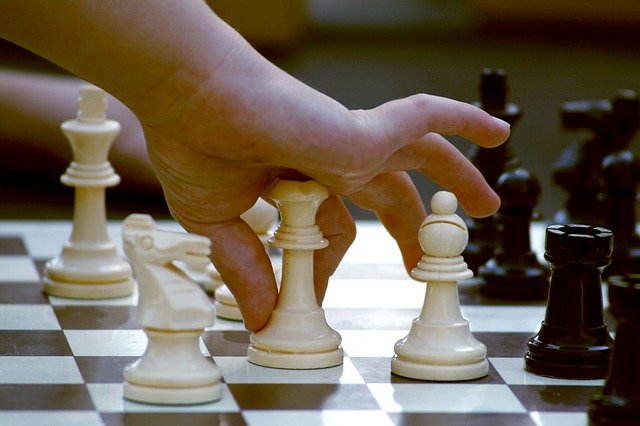
The Chess it's a play that takes place on a board and that faces two people. Each player has sixteen pieces that he can move, respecting certain rules, on the board that is divided into sixty-four squares, known as squares.
These pieces are a King, a Queen, two towers, two horses, two bishops and eight pawns. The objective is to get to overthrow the opponent's king, for which it is possible to capture the various pieces of the opponent.
Each chess player begins the game with sixteen pieces.
Game features
The board alternates in its squares two colors, usually black and white. The pieces are also distinguished by color: one player starts the game with sixteen black pieces and the other with sixteen white pieces. The way in which each piece can advance across the board is defined by the regulation, and in the features of its possible movements is a large part of the essence of the game.
If a player manages to get one of his pieces to the square where there is an opponent's piece, he can capture her. In this way, the opponent loses one of his pieces. The game is defined when a player gets the King opponent cannot evade a capture maneuver: such a move is known as checkmate.
Although historically chess pitted one person against another, in recent decades the technology allowed the emergence of computer programs that, through various calculations, "they play" to chess, determining the movement of the pieces. In this way, a person can play against a computer (computer), or it is even possible that two computer systems face each other.
Chess moves
Pawn
On the chessboard, there is no weaker and more numerous piece than the pawn. His movement more frequent it is towards the front, one square; however, the starter can take two steps at the same time. One of its peculiarities is that it cannot capture other pieces in the same way that it moves, unlike all the others, but must do so diagonally.
Bishop
Its movement is diagonal and does not have a limit of squares: as long as it finds empty spaces, it can continue advancing to the edge of the board. Something that follows from this rule is that the bishop can never step on a square of the Colour opposite to initial. As each player has a bishop on a black square and another on a white one, it is common to take advantage of this to name them, although they can also be identified according to their proximity to the king or queen.
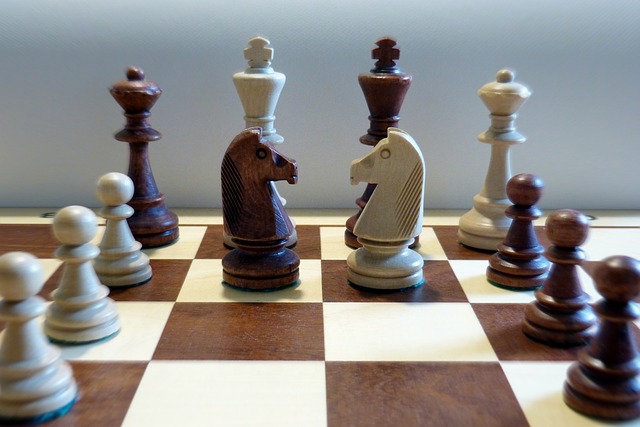
The squares on the chessboard are called squares.
Tower
It could be said that the rook is like the bishop but in a straight horizontal or vertical line. In addition to the orientation of its movement, a difference it presents with the latter is that it can be positioned in any square on the board, something that makes it very powerful.
Horse
It is the piece that stands out the most from the group, since it is the only one capable of jumping over other pieces. Its movement consists of moving two squares in line horizontal or vertical line, and then move one more forward at a right angle, as if writing a letter L in its wake.
Queen
It is the most powerful piece in the game, since it combines the possibilities of the bishop and the rook.
King
Despite its importance, it is one of the least powerful pieces on the board. His movements are limited to any of his adjacent squares, so he cannot advance more than one step at a time.
Particularities of the pieces
Although each piece has an exclusive series of possible movements, it is important to note that there are certain similarities between one and the other, something logical given the limitations of the board design. For example, all the pieces except the knight must move along a line, be it diagonal, vertical or horizontal, while he must form an angle in his path, as explained above. Another common point that applies to all pieces is that none can move beyond the limits of the board, not even to return later.
The knight is also the only piece that can pass over others: all the others need a clear path to advance, that is, both the final square and all the intermediate squares must be free to consider the move valid. No piece can end in one cell that is occupied by another of the same color.
Leave a Reply