
bishop
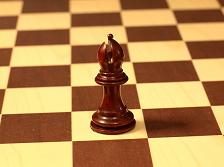
The bishop It is one of the pieces of the Chess. Regarding your movements, you can move forward or backward in diagonal for all free squares. It should be remembered that chess is a game whose games are played on a board divided into sixty-four squares or squares.
Chess faces two players. Each receives sixteen pieces: between them, two bishops. The bishop cannot move vertically forwards or backwards, nor horizontally to either side. Its movement always takes place diagonally, either upward or downward.
By their movements, the bishops remain the entire game in the same color of checker in which the play, a peculiarity that, although it may seem superficial, distinguishes them from the rest of the pieces. That is to say: if a bishop is located in the white square, it cannot go to a dark square at any time.
Another characteristic of the movement of the bishops that we must take into account is that they cannot jump pieces, but, when encountering a rival piece, they take their place and capture it. In fact, the only one capable of jumping over other pieces is the knight.
Historians say that, in the ancient games that preceded the development of chess, bishops did not exist. The piece was added in the XII century, when chess had already been installed in the continent European.
With respect to its meaning, the bishop piece is the representation of the adviser war or spiritual aid to royalty. In fact, the shape of its upper end refers to the miter, the typical cap of the bishops.
According to experts, the bishop has a relative value that is three or three and a half points higher than the value of the bishop. pawn. When the player has both bishops, the value of each piece is increased. However, there are chess players who downplay the importance of bishops and are even willing to sacrifice them as part of their strategy.
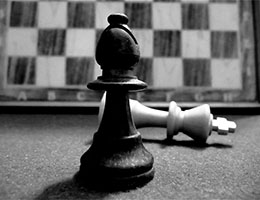
For those who appreciate the power of this piece, the bishop can become a very powerful weapon when crafting long-distance attacks and threats; In order for these plays to be carried out, it is first necessary to clear all the diagonal path that you will have to travel.
Many professional or expert players use the bishop for both their offensive and defensive tactics. The fact that he cannot step on the squares of the opposite color to the one assigned to him at the beginning of each game can be taken as a disadvantage; However, we can always assign you the protection of the cells of your Colour, with cunning movements that leave you alert to the attacks of the opposing team.
Since it is one of the few pieces that can advance as many spaces as free squares are in its path, some restless people venture to move it as soon as they can and thus unnecessarily expose it to the opponent; something similar happens with the rook, the queen and the knight, since their «agility»Breaks with the slowness of chess. Needless to say, impatience often leads to defeat.
In the universe of comics of X-Men, there is a character named Lucas Bishop Williepondt to which they are usually addressed simply by Bishop, which in English means "bishop"; in fact, in some translations it is mentioned with this term in Spanish. Its first appearance took place in 1991 and was created by Jim Lee and Whilce Portacio. Bishop is born to an Aboriginal family who fled Australia just before it was destroyed by a nuclear attack and took refuge in the United States.
Leave a Reply