
aorta
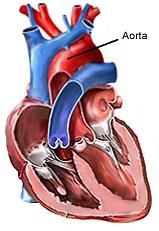
Before entering to define the concept of aorta, it is necessary that we determine its etymological origin. Specifically, this is found in the Greek and more exactly in the word άορΤή, which in turn comes from the term άείρειν, which could be translated as "raise".
is defined as aorta to artery that originates from the ventricle located in the left region of the heart muscle and that forms an arch and extends towards the abdomen area. There, at the level of the fourth lumbar vertebra, it has a bifurcation that extends into two smaller arteries, which are called primitive iliac.
And that without forgetting that it is also necessary to underline that this artery is the largest of all those that exist in the human body.
Since the aorta constitutes the starting point of the rest of the arteries that are part of the circulatory system (with the exception of pulmonary, which come out of the Right ventricle), is considered medically as the most important artery in the human body. Its function is to allow the transfer and guarantee the distribution of oxygen-rich blood to the other arteries.
The aorta is an artery with characteristics elastic that has flexibility and it's possible to extend. As the left ventricle contracts to supply blood to the aorta (a process known as systole), an expansion occurs in it, which gives it the potential energy to help maintain blood pressure when the artery ends up contracting passively (diastole).
There are several diseases or pathologies that can affect said artery, such as coarctation, which can be defined as a congenital defect in the heart and that what it means is that it is affected by a narrowing. This means, among many other things, that the person in question who suffers from it has a greater chance of developing an infection in the aorta.
Likewise, mention must also be made of what is known as an aneurysm. This pathology is totally contrary to the previous one and is that it consists of the abnormal widening of the artery in question. In this very specific case, which can lead to a break in the wall of that one and therefore the patient sees his life seriously endangered.
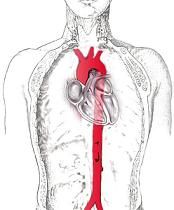
Among the different recognizable segments in this artery are the so-called ascending aorta (a portion that is located between the heart and the arch, where the coronary arteries that carry blood to the myocardium originate), the bow or aortic arch (whose appearance resembles a letter U but inverted and stands out for marking the beginning of the brachiocephalic trunk, the primitive carotid and the left subclavian) and the descending aorta (extending from the aortic arch and ending in the division of the iliac arteries). Mention may be made of thoracic aorta as the middle of the descending aorta that is located on the diaphragm and at the abdominal aorta as the part of the descending aorta that is located below the diaphragm and that reaches the bifurcation of the artery.
In addition to all the aforementioned, we can add that aorta is a word that is part of a broader term: aortic arch. With it, the arch that the aforementioned artery forms from its birth to the abdomen is defined.
Leave a Reply