
afferent
The adjective afferent has its etymological origin in the Latin word affĕrens. In the broadest sense, this qualifier applies to what moves or carries something.
The notion is often used in the field of biology and of the anatomy. An afferent is a formation whose function is transmit substances or energy from one sector of the body to another more relevant in this context. By extension, substances or stimuli that are transmitted in this way are called afferents.
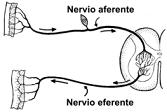
The afferent neuronsIn this framework, they are responsible for the transport of nerve impulses from the receptor organs to the Central Nervous System (CNS); the reverse process is developed by the efferent neurons, which carry nerve impulses out of the CNS. These neurons have a single, large dendrite and a short axon; its body has a rounded appearance and a smooth texture.
An afferent neuron, therefore, transfers the impulse to the CNS from the sectors that are located around it. You can distinguish between visceral afferent neurons (which are responsible for the stimuli from the viscera) and the somatic afferent neurons (related to pain, temperature, etc.).
In this context, we can say that human beings perceive the world around us through mechanisms physiological that take place when we process the afferent information; Some of the key points are the conversion into codified nervous activity from the energy coming from the stimulus, thanks to which we access data such as the location, intensity, duration and quality of the stimulus in question.
The coding of action potentials gives rise to various temporal patterns, via various nerve fibers. Saying code it is the representation of data coming from the outside world and, as is often the case when interpreting a symbol, it can differ considerably from the elements it represents.
Sometimes it happens that the encoded afferent information is incorporated into the conscious awareness of the material environment, that is, it has a conscious correlation. This type of information is known as sensory, while the experience of events and objects in the world around us that occurs consciously and enters through nervous processing is called perception.
The body of the afferent neuron is found in small ganglia that are located on both sides of the spine. It is divided into two parts: the peripheral fiber, which extends to a sensitive end and is the largest; that which penetrates the spinal cord through the dorsal root.
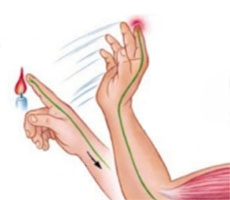
In the nervous system there are three phenomena that are related to each other in a kind of circle: feeling, decision and reaction. It is a process that takes place through the action of afferent, efferent, and interneurons. A very common example can be contact with the flame of a candle, which is followed by a sensation of pain, after the information has been carried to the brain through afferent neurons, a reaction to pain, and a decision regarding how we will relate to fire in the future.
The afferent system, also know as sensory system, is dedicated to the processing of sensory data. The five senses are part of the afferent system, which allows receiving the stimulus and then transmitting it and enabling the necessary response in each case, according to the characteristics of the stimulus in question.
It is known as afferent arteriolesfinally, to the blood vessels that supply the nephrons (the most important functional units of the kidneys). These vessels help regulate the blood pressure.
Leave a Reply