
Activism

Activism can be defined as any social, political, economic, ecological or religious movement that occurs in order to achieve change.
Certainly, activism groups together a group of people who come together to protest either against something or on the contrary because they speak out in favor of something.
Likewise, they are well-organized groups that can use different forms of protest and are driven by different causes to carry out their activities.
In addition, the most common ways activists speak out are strikes, demonstrations, blocking roads, proposing laws or projects, and presenting lectures on specific topics.
Likewise, in some cases these movements can be dangerous because they can degenerate into violent acts, which, instead of helping, harm society.
Ideas and goals that drive activism
For this reason, what mainly moves activists is the idea that they can achieve certain changes in the concrete reality of a society. Of course, these changes must generate benefits for the majority of its inhabitants and in the ideal case for the whole of society.
In fact, the activist is characterized by being a citizen who cares about his community and that is why he is involved in these movements to achieve the objectives that are proposed in favor of generating social benefits.
In reality, he is concerned about the problems of a society and proposes solutions to achieve the changes, which will provide the expected solution.
Examples of activists around the world
With all this, all independent activism of any kind has as a common characteristic that they promote an important change within society. Among some of the most relevant examples we will mention several.
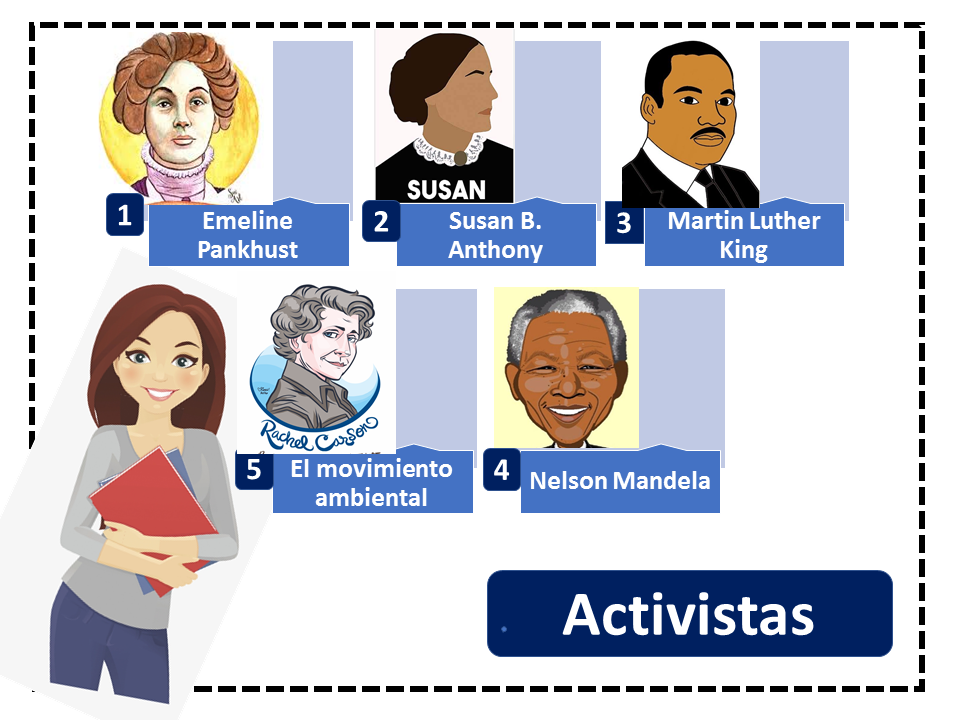
Emeline pankhust
It turns out that, in 1889, the Women's Franchise League was created in England, founded by the English Emeline Pankhurst. Emeline led many demonstrations and protests in England because women did not have the right to vote.
He went so far as to take extreme measures such as hunger strikes, but finally on July 2, 1928, the right to vote for women was legalized in England.
Susan B. Anthony
She was also a defender of the right to vote for women, her activist action was carried out in the United States. In 1852 the suffragettes joined the movement, making speeches to defend the rights of women to vote, have the right to own property and profits. In the same way, he fought for the labor rights of women.
Finally, on August 18, 1920, American women obtained the right to vote.
Martin Luther King
Instead, Martin Luther King was a United States activist who fought for the civil rights of African-American people, holding peaceful demonstrations, especially during the 1950s to 1960s.
His cause of struggle was against racial discrimination in the United States, his most important speech was "I have a dream." He received the Nobel Peace Prize on October 14, 1964.
Nelson Mandela
Similarly, Nelson Mandela is remembered for his activism in South Africa, fought against apartheid, was imprisoned for leaving his country without permission, and was accused of inciting strike movements.
That is why he was sentenced to life imprisonment, there he wrote his speech "From the bench" in 1964. Where he expressed the dream of a democratic society, where blacks and whites could live harmoniously and with equal opportunities.
He was democratically elected as president on May 10, 1994, ruled for 27 years.
The environmental movement
It emerged in 1969, after an oil spill occurred in Santa Barbara in the United States. It is a movement that succeeded in promulgating the National Environmental Policy law in 1970.
Likewise, in 1970, Earth Day emerged and the Environmental Protection Agency was born. From that moment, laws are generated to protect ecosystems, to preserve species and to seek environmental sustainability.
To conclude, we can say that activism can generate positive effects and changes in societies that face some kind of economic, social, political, religious or ecological problem.
However, activists' actions must be directed appropriately, because taken to the extreme they could cause problems of violence or achieve results that only benefit one group in society to the detriment of the rights of others.
Leave a Reply