
absorbance
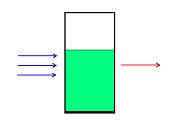
The concept of absorbance It is used in the field of physical. It's about the measure what reflect how radiation is attenuated when it passes through an element. The absorbance can be expressed by a logarithm that arises from the link between the intensity that leaves and the intensity that enters the substance.
Also mentioned as absorbency (the act of absorbing: attracting something to incorporate or consume it), the absorbance depends on the concentration and the thickness of the sample. This proportional relationship differentiates this measure from the transmittance, whose magnitude reflects the amount of Energy that passes through an element in a certain unit of time.
The breadth of the concept of transmittance makes it possible to distinguish two types: transmittance thermal and the optics. The first is the one exposed in the previous paragraph and it can be added that the element that the energy passes through is called constructive, since it is part of a construction site, and its faces they must be parallel to each other.
Optical transmittance can be defined as the portion of incident light that manages to pass through a show, maintaining a given wavelength, and is expressed by means of the equation sample light intensity on intensity of the incident lightning. Typically, the result is presented as a percentage.
Once the light passes through a sample, the value equivalent to its intensity, and for this it is essential to know its wavelength, that is, the real distance that a wave travels in a given time interval. This segment in time is the one that takes place between two maximum points of any of the physical properties of the wave, and they must occur consecutively.
For the electromagnetic waves, this physical property could be the electrical effect: as the wave moves forward, it approaches a maximum, then decreases until cancellation, acquires a negative value and reaches its minimum (a concept that we can also call negative maximum). As expected, this process is repeated indefinitely, which is why it also occurs in the opposite direction until another positive maximum is reached.
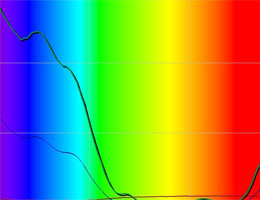
When absorbance is calculated per unit length, on the other hand, the idea from optical density. This physical magnitude specifically refers to the level that an optical element absorbs according to the unit of distance, taking into account a given wavelength.
Other points dealt with in this definition also come into play in the concept of optical density: in addition to the distance traveled by light in a given sample, that is, its thickness, which is measured in centimeters, we must take into account the absorbance value, the transmittance value and the intensity of each ray of light, both the one that hits and the one that is transmitted. As a reference data, there must be an inverse ratio between optical density and transmittance: the larger the first, the shorter the second.
Spectrophotometry indicates that absorbance is calculated by dividing the intensity of the light that passed through a sample due to the intensity of the light that existed before entering said sample. In other words: the intensity that goes out or is transmitted is related to the intensity that enters or incident.
The absorbance, in short, quantifies the phenomenon What happens with light radiation and substances. As light falls on the sample, a part of the radiation is absorbed by the substance. The light that is not absorbed passes through the sample: when it is captured by a receiver located on the other side, the measurement is possible.
Leave a Reply