
layered
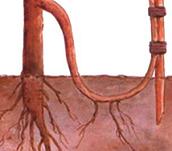
Layered it's a concept that is linked to the verb layer: bend something in the manner of a elbow (the prominent sector of the joint that joins the forearm with the arm, or that bent in an arch or angle).
The idea Layering is used in the botany and in the agronomy to name a plant propagation mechanism. Acodar, in this case, refers to bend the stem or stem of a plant to introduce it under the earth, so that it takes new roots there, but leaving its tip outside.
The layering, in this way, allows to obtain new specimens that present the same characteristics of the original plant. By curving the stem and burying it, the sap is directed towards that sector, favoring the emergence of the roots. The ideal time to develop layering is spring, when the sap begins to move through the plant. It is important that the land where the layering is carried out has a good level of humidity and is fresh.
Although the ground layer is the most frequent, you can also appeal to air layering, which consists of bending branches that are high or thick, making ligatures so that the sap stops in a sector.
In other words, layering in botany is a technique used to get plants to reproduce. asexually, starting from a branch of the mother that has not yet been extracted from it, in which the sprouting of the new roots takes place. Bliss branch it should only be separated from the mother plant when the roots have emerged. As in other methods of reproduction, the plants resulting from the layering are identical to the original from a genetic point of view.
The technique Layering is more complex than that of cuttings, and therefore less common among gardening enthusiasts. Cuttings are fragments that we can extract from plants to obtain new specimens, after subjecting them to a certain process to generate roots.
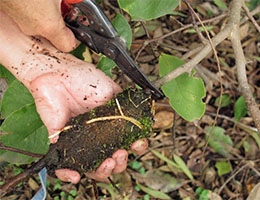
One of the advantages of layering over cuttings is that it allows us take advantage of the nutrients and water of the mother plant for the new roots. It should be noted that human intervention is not necessary for this process to take place in nature: on the contrary, it is observed in many cases in which the branches of a plant reach the level of the I usually and generate the so-called adventitious roots.
On the other hand, the adventitious roots are those that do not arise from the radicle of the embryo, but are produced in any other part of the plant, such as in the old roots, the underground stems or a part of the stem.
As mentioned above, layering is not a simple technique, and therefore it is advisable to take into account certain tips to obtain the best results:
* water with plenty of water, so that you never miss humidity on the floor;
* make an undercut at the bottom of the portion of the branch that we buried. This promotes the birth of new roots;
* keep the stem in a dark area, either buried or covered with a mound of earth. The Balance between moisture, light and heat is essential for the success of the layering.
The notion of layering can be used in the architecture. Layering is called the projection of a segment (the sector that forms a vault or an arch) that extends in its lower part and the molding that protrudes to develop the frame of the span.
Leave a Reply