
adsorption

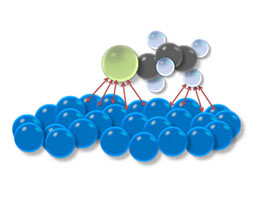
Adsorption it's a concept used in the field of physical with reference to process and the result of adsorbing. This verb refers to the attraction and retention that performs a body in its surface of ions, atoms or molecules that belong to a different body.
Through adsorption, a Body manages to capture the molecules of another and keep them on its own surface. In this way, adsorption differs from absorption, where molecules penetrate its surface.
Adsorption can be carried out in different ways, according to the link established by the adsorbate and the adsorbent. Let's see below the three types of adsorption that are recognized, taking into account the attraction that exists between the two components just mentioned as a parameter to determine the classification:
* physical adsorption: it is the one that takes place due to the forces or Van der Waals interactions, a concept of physicochemistry that refers to the forces of attraction or repulsion that exist between molecules, or between different portions of the same. These forces are different from those that occur by an intramolecular bond or by the electrostatic interaction of neutral molecules with ions, or of several ions with each other.
In the case of physical adsorption, the adsorbed molecule does not bind to a particular point on the surface, and for this reason it has total freedom to move in the interface;
* chemical adsorption: it takes place when the adsorbate forms strong bonds in the active centers of the adsorbent;
* exchange adsorption: as it happens in the vicinity of an electrode with loadThis type of adsorption occurs when, due to electrostatic attraction at charged points on the surface, ions of a substance are concentrated there.
In summary, it can be said that adsorption causes the formation of a gaseous or liquid layer on the surface of a solid, or of a gaseous layer on the surface of a liquid, which is generated when molecules that are in a certain phase are retained on the surface of the body.
Adsorption applications
The principles of adsorption apply in very different fields. In the world of industry, one of its most popular uses is to take advantage of it to extract moisture from compressed air. To do this, the compressed air is passed through a bed of some material that, before the water molecules, manages to generate adsorption (this can be carried out with the active alumina, for example).
To saturate the bed, the air or gas must be subjected to a certain Pressure, so that the molecule of the bed adsorbs that of the water. On the other hand, its regeneration implies releasing the compressed air to the outside and allowing a stream of pre-dried air to pass through the bed. In general, adsorption dryers are developed that consist of two columns: one adsorbs while the other is regenerated by the dry air of the first.
Adsorption is also used in the following processes: Water treatment; elimination of odors, colors or flavors in certain products, such as sugar syrup and oils, to meet industry standards; wastewater treatment, which carries out different biological, chemical and physical actions to get rid of pollutants that result from human use; air drying; elimination of moisture in fuels.
Adsorption is also applied to obtain nitrogen, and for this, compressed air is allowed to pass through the adsorbent bed.
Leave a Reply