
Variable costs
What are variable costs?
The variable costs, also known as variable cost, They are those costs that vary according to the production carried out in a company or organization, that is, with the amount of goods or services that are being produced.
The more an organization produces, the more variable costs it must pay. For example, more product packaging or more raw materials.
In short, and unlike fixed costs, variable costs vary according to the number of units produced.
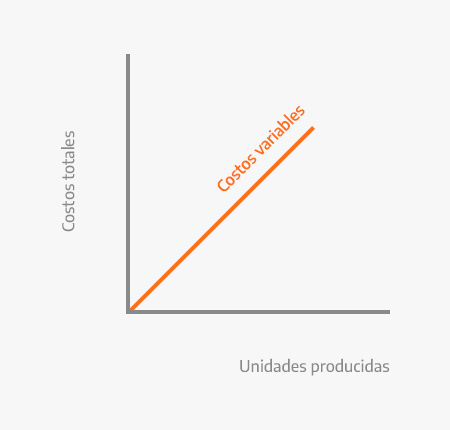
Representative graph of variable costs.
Variable cost characteristics
Among the main characteristics of variable costs we can highlight that:
- They are controllable in the short term.
- They do not depend on time but the volume of units produced.
- They are proportional to the activity.
- They are controlled and regulated by management of the organization.
Classification of variable costs
Variable costs can be proportional, progressive or regressive.
Proportional variable cost
Those costs strictly linear to the activity. These vary according to the volume of what is produced.
- Example: materials needed to produce a certain product.
Progressive variable cost
Those costs that vary in proportion to what is produced.
- Example: workforce; the more they produce, the more hours employees are paid.
Regressive variable cost
Those inverse costs at the production level. The more production, the less cost.
- Example: purchase of materials in a wholesale way, with a discount for quantity.
Examples of variable costs
Here are some examples of variable costs:
- Workforce: the more demand there is in a company, the more staff will be needed.
- Materials: the more demand for a product there is, the greater amount of raw material will have been needed.
- Selective taxes: taxes on luxury items, alcoholic beverages or banking services.
- Product packaging: its cost will depend on the amount of product that is sold.
- Sales commissions: when the employee's salary depends directly on the amount of sales he makes.
Leave a Reply