
Stratified sampling

What is stratified sampling?
Stratified sampling is a type of probability sampling that consists of dividing the entire population, on which an investigation will be carried out, into different strata or subgroups.
Generally, these strata are made up of individuals who share similar characteristics.
Once the population has been stratified, select, randomly and proportionally, the final individuals of each of the strata that will make up the statistical sample.
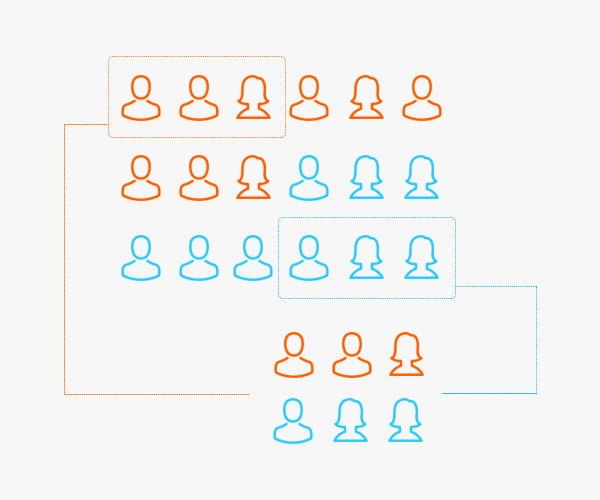
In orange and light blue, two different strata, from which people will be selected at random.
Stratified sampling types
Depending on the size assigned to the strata, stratified sampling can be proportionate or disproportionate stratified sampling.
Stratified sampling provided
It is called proportionate stratified sampling when the size of the sample, of each of the strata, is proportional to the size of the population.
For example: to obtain a sample of 100 individuals from a total population of 3000, the population is divided into the following strata:
- Stratum 1: 1,300 individuals.
- Stratum 2: 1100 individuals.
- Stratum 3: 600 individuals.
Through the stratified sampling provided, the sample obtained from each stratum will be representative of each of these and will provide the following results:
| Stratum | Individuals | Percentage | Show |
|---|---|---|---|
| 1 | 1300 | 43.4% | 43 |
| two | 1100 | 36.6% | 37 |
| 3 | 600 | twenty% | twenty |
In this way, the sample of 100 people would be made up. This type of stratified sampling it leaves at a disadvantage those groups or strata that are made up of the least amount of people.
Disproportionate stratified sampling
Disproportionate stratified sampling allows the researcher carry out an equitable sample, regardless of the number of individuals that make up the population of the stratum.
For example: to obtain a sample of 100 individuals, from a total population of 3000, the population is divided into the following strata:
- Stratum 1: 1,300 individuals.
- Stratum 2: 1100 individuals.
- Stratum 3: 600 individuals.
In this way, through disproportionate stratified sampling, the following results would be obtained:
| Stratum | Individuals | Percentage | Show |
|---|---|---|---|
| 1 | 1300 | 43.4% | 3. 4 |
| two | 1100 | 36.6% | 33 |
| 3 | 600 | twenty% | 33 |
In this way, the sample of 100 people with equitable results would be made up. However, said sample cannot be considered completely probabilistic for all stratum, since the individuals of the group with fewer people have more possibilities of being selected for the sample than the other strata.
Advantages and disadvantages of stratified sampling
Advantage
The advantages of stratified sampling are as follows:
- It has greater ability to make inference and comparisons within a group.
- Has minimal errors in samples of the same size, so you need small samples so that there is the same margin of error.
- The samples are more representative, since the elements of each stratum or group are represented in the sample.
- The researcher can gain more knowledge of the population addressed.
- Allows you to apply various research methods and procedures in the different strata.
- Enables analysis of patterns within stratum and the separate notification of the results for each of the strata.
Disadvantages
The disadvantages of stratified sampling are as follows:
- It is necessary to obtain information on the proportion of the population belonging to each stratum.
- Information is required on the stratification variables of each element of the population, since otherwise the compilation can be very expensive.
- It is a more expensive method, as implies time and it is complicated compared to other methods.
- If you have a large number of variables, the selection of the stratification will be more difficult.
Stratified sampling example
To conduct research on the number of people who consume alcoholic beverages in the Argentine Republic, the investigator in charge decides to use stratified sampling, thus dividing the population into different groups, according to age.
In this way, divide a total population of 45 million people in the following strata:
- People under 18: 20 million.
- People over 18 and under 35: 15 million.
- People over 35 years: 10 million.
From this subdivision, the sample is formed, obtaining in a proportional way 10,000 people:
| Stratum | Individuals | Percentage | Show |
|---|---|---|---|
| 1 | 20 mm | 44.4% | 4450 |
| two | 15 mm | 33.3% | 3330 |
| 3 | 10 mm | 22.2% | 2220 |
In this way, the statistical sample of 10,000 people is formed, with which you can carry out an investigation arising from 3 different strata of the stratified sample.
Leave a Reply