
Solvency ratio

What is the solvency ratio?
The solvency ratio is an index that shows the capacity of a company to face the payment of all debts contracted by your organization.
The solvency ratio formula measures the fulfillment of the commitment of the entity to cancel all its obligations, both current and non-current liabilities, in a timely manner and without delays.
Likewise, it reflects that in the future it will be possible to continue acting potentially in the same way.
Within the business sphere, solvency is the power that a company has to meet its obligations on due dates. The opposite of solvency is the state of insolvency, which consists of the objective inability of an entity to meet the existing obligations on a regular basis, that is, within the agreed terms and with the normal means of payment.
How is the solvency ratio calculated?
To determine the solvency ratio, it will be necessary to take the balances shown in the statement of financial position of all the asset accounts, and also include all the liabilities:

Formula to calculate the solvency ratio.
Taking into account that:
Considering the concept of liquidity, this ratio involves the total guarantee of the assets at the time the general payment of the liabilities is settled or made, before considering the payment of the shareholders' equity.
Analysis of values
In the solvency ratio, total assets are placed in the numerator and total liabilities in the denominator. Therefore, for there to be solvency, this result must be greater than 1, the possible scenarios being the following:
- Result less than 1: This situation reflects that the company is in serious financial trouble and that this could lead to bankruptcy.
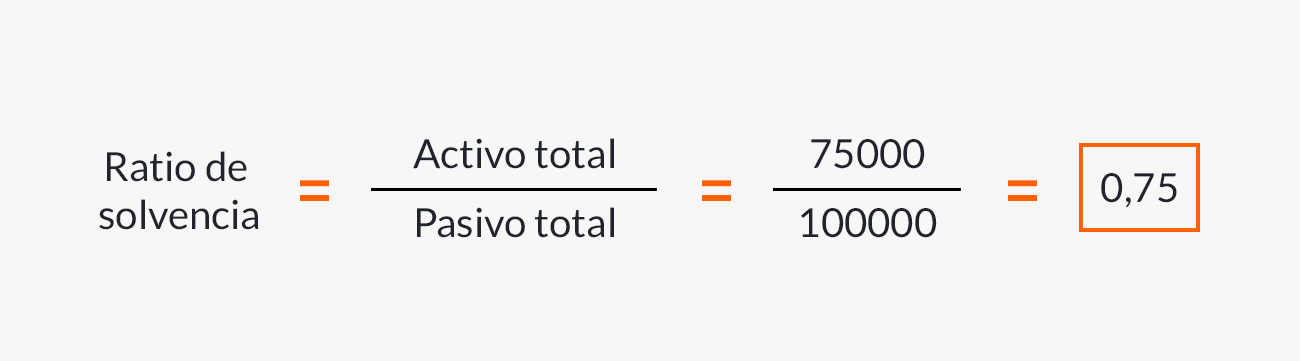
- Result less than 1.50: in this case the entity has a delicate situation, for which the management must take corrective measures.

- Result equal to 1.50: here the company shows a context of financial equilibrium in case of economic problems in the organization.
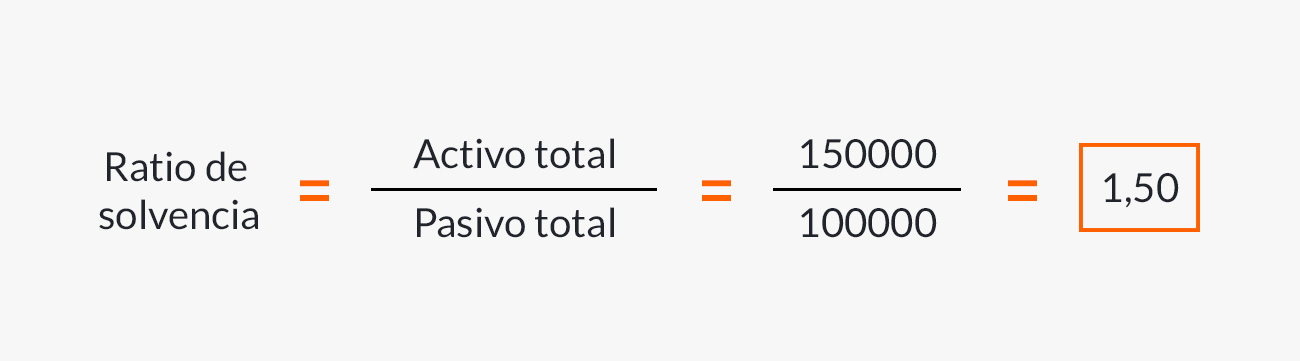
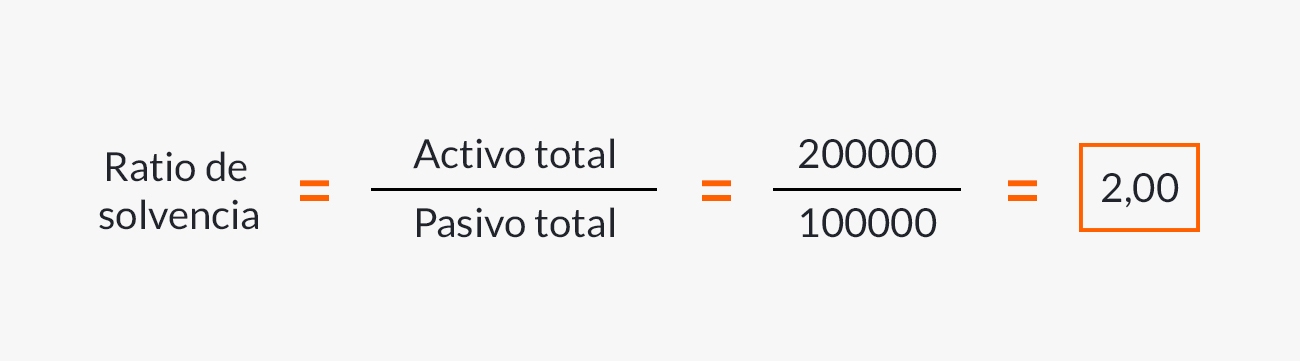
- Result greater than 1.50: a result of this type indicates that there is a portion of assets that exceeds what is convenient, making the organization solvent.
Solvency ratio example
Below is a practical example with the financial position of the company X, Y, Z, CA., with which the solvency ratio can be determined:
| Current assets | Current liabilities | ||
| Cash and equivalents | 5,000 | Bank debts | 45,000 |
| Trade accounts receivable | 20,000 | Accounts payable suppliers | 20,000 |
| Inventories | 37,500 | Other current liabilities | 5,000 |
| Other current assets | 2,500 | ||
| Total current assets | 65,000 | Total current liabilities | 70,000 |
| Non-current assets | Non-current liabilities | ||
| Property, plant and equipment | 80,000 | Long term passives | 45,000 |
| Permanent investments | 30,000 | ||
| Total non-current assets | 110,000 | Total non-current liabilities | 45,000 |
| Total assets | 175,000 | Total liabilities | 115,000 |
| Stockholders' equity | 60,000 | ||
| Total liabilities and capital | 175,000 |
Applying the solvency ratio to the financial statement shown, the calculation would be as follows:

So the company yields a solvency ratio of 1.52. This could be interpreted as follows:
- X, Y, Z, CA It is a solvent company, because its total assets are higher than all its liabilities (that is, it has more than it owes).
- The entity has 1,522 assets for each liability recorded, so it is very close to financial equilibrium with regard to the solvency ratio.
- Finally, it should be noted that although the company has a solvency situation, its statement of financial position reflects liquidity problems, since current liabilities exceed current assets.
| Bibliography: |
|---|
|
Leave a Reply