
Liquidity index

What is the liquidity index?
The short-term liquidity or solvency ratio is a index that indicates the possibility that a company has to convert assets into cash, or its ability to obtain cash and thus meet current obligations.
The information on the expected dates of realization of assets and liabilities is useful and necessary to evaluate the liquidity of an entity, it should be noted that liquidity applies to the short term, that is, to periods of one year or less.
The liquidity ratio, also known as running ratio or circulating, should not be confused with the solvency ratio, which includes both current and non-current assets and current and non-current liabilities. An entity may be solvent, but nevertheless has liquidity problems due to the structuring of its current and non-current assets, or with respect to short-term debts.
What is the liquidity index for?
An important aspect to analyze the liquidity of a company, is how convertible to cash are current assets Y how enforceable are the liabilities. This will largely depend on the nature of the sector where the company is located.
Short-term or current debts are guaranteed by all current asset values, such values constituting immediate availabilities or the possibility of converting them in a short period of time, which is why they are considered the support for current liabilities.
Current assets, through the completion of the business cycle of the company, must produce the necessary cash so that current debts are paid in a timely manner, and thus demonstrate the short-term solvency of an organization.
How to calculate the liquidity ratio?
Current or short-term assets fall into the following categories:
- Available: cash or temporary investments convertible into money in a short period of time.
- Required: accounts receivable.
- Achievable: inventories.
Based on this classification of current assets, 3 ratios related to liquidity can be identified:
- Current ratio: takes into consideration for its calculation the 3 categories of short-term assets, available, payable and realizable.
- Acid index: for whose determination the category of realizable assets is excluded.
- Super acid test- In which only available assets are included in the index.
Current ratio
The current ratio is equal to current assets over current liabilities:

Formula to calculate the liquidity index based on the current ratio.
This is used to measure the ability to meet current obligations from all short-term assets.
There is no predetermined value so that the current ratio can be interpreted as convenient in general terms, since this will depend on the particular circumstances of each company.
It should be noted, however, that current assets must exceed current liabilities. In other words, the ratio must be more than one current asset for each current liability, otherwise there would be a working capital deficit.
The results of the current ratio should be explained, for example, taking into account the quality of the client portfolio, the collection management, the age and physical condition of the inventories, as well as the payment conditions of the debts incurred, among other important variables to take into consideration.
Acid index
The acid ratio is a stronger liquidity ratio than the short-term solvency ratio. It is found dividing current assets by liquid assets (cash, negotiable securities and accounts receivable), between current obligations:

Formula to calculate the liquidity index based on the acid index.
In this reason, inventory is not taken into consideration because it usually takes some time to convert it into cash.
Prepaid expenses are also not included, since they are not convertible into money and, therefore, they are not able to cover current obligations.
The interpretation of this index is made from how many assets are readily available, without having to resort to the sale of inventories, since it is considered that accounts receivable can be disposed of with a single action (that of demanding payment), while inventories require realization and enforceability (two operations) .
Super acid test
Measure the Ability of the company to cancel its short-term obligations with the availability of cash in cash and banks, as well as with readily available securities, not including other current assets:

Formula for calculating the liquidity ratio based on the super acid test.
This ratio is the extreme of the liquidity ratios, and it matches the company's available and quasi-available money versus the current debts incurred.
The super acid test is also known as the absolute liquidity ratio, immediate solvency, or cash ratio. It is the most rigorous index since it measures the effective payment capacity of the company in a peremptory period.
Calculation example
The following is a practical example of the statement of financial position of company A, B, C, SA, which is used to determine the 3 indices related to liquidity referred to above:
| Current assets | Current liabilities | ||
| Cash and equivalents | 15,500 | Bank debts | 45,000 |
| Trade accounts receivable | 31,000 | Accounts payable suppliers | 22,500 |
| Inventories | 65,000 | Other current liabilities | 10,000 |
| Prepaid expenses | 5,000 | ||
| Total current assets | 116,500 | Total current liabilities | 77,500 |
| Non-current assets | Non-current liabilities | ||
| Property, plant and equipment | 80,000 | Long term passives | 70,000 |
| Permanent investments | 31,000 | ||
| Total non-current assets | 111,000 | Total non-current liabilities | 70,000 |
| Total assets | 227,500 | Total liabilities | 147,000 |
| Stockholders' equity | 80,000 | ||
| Total liabilities and capital | 227,500 |
Using the figures from the financial statement shown, the following results are obtained:
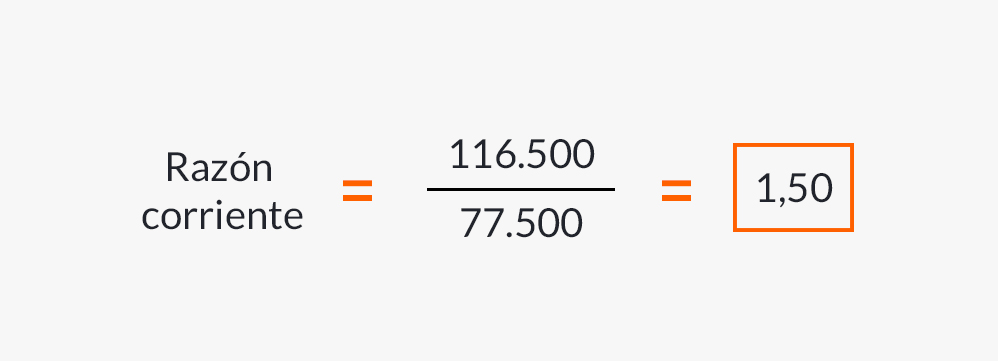
The calculation indicates that the company has 1.50 current assets for each current liability, or 150% in percentage terms. This means that for each liability that becomes due, there is 1.50 of current assets that are being converted to cash.
Considering the result, it could be affirmed that the company has a adequate short-term or current solvency.

By excluding inventories and prepaid expenses from total current assets; the remaining current assets, that is, cash and accounts receivable, represent 60% of total current liabilities. That is to say that without having to resort to the sale of inventories, it is possible to pay off more than half of the current debt in the short term with the available and payable assets, which is a convenient result.
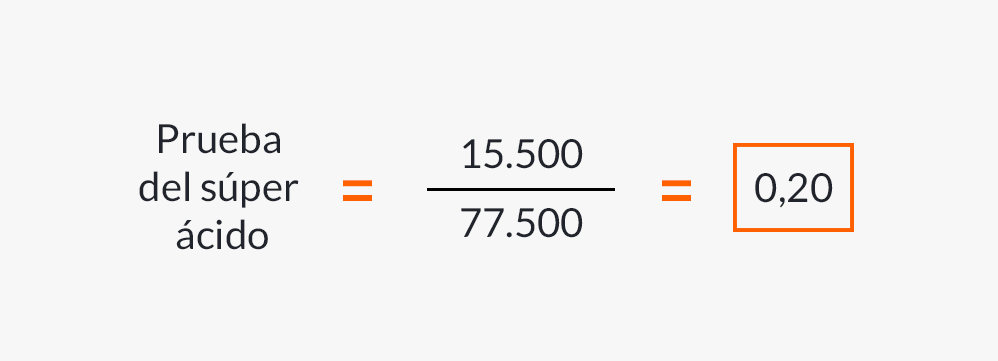
When dividing the cash of the company, shown in the financial statement, between the total of the short-term debts, it is obtained that the available assets represent 20% of the current liabilities. This ratio could be considered reasonable, since with available cash, one-fifth of short-term debts can be dealt with immediately.
| Bibliography: |
|---|
|
Leave a Reply