
I will pay
What is a promissory note?
A promissory note is a accounting document by which a person agrees to pay another a certain amount of money, on a certain date.
In other words, it is a title by means of which a person (debtor) agrees to pay a specified amount of money to another person (creditor or beneficiary).
Who is involved in the promissory note?
When creating a promissory note, the following people intervene:
- The transmitter: person who agrees to pay the amount of money established in the promissory note on the due date indicated.
- The beneficiary: also known as the holder, he is the one who will collect the sum of money stipulated in the document once paid by the issuer.
- The guarantor: Sometimes a third person usually appears who works as a "guarantor" that the issuer can make the payment stipulated in the promissory note.
Requirements of a promissory note
For a promissory note to be considered valid, it must contain the following elements:
- The denomination of "promissory note" in the document.
- The amount and the amount determined, together with the currency to be paid.
- The indication of expiration. In the event that the promissory note does not indicate an expiration date, it will be considered payable on demand.
- The place where said promissory note is made effective.
- The Name of individual to whom the payment is to be made or whose order is to be made. Blank promissory notes are not issued, which do not indicate the beneficiary.
- The date and place where the promissory note was signed together with the issuer's signature and its clarification.
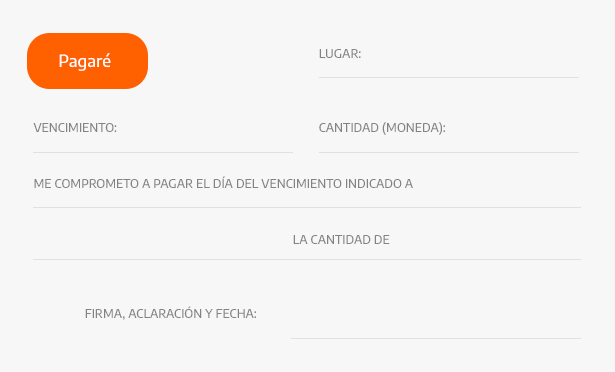
Example of promissory note and its elements.
Types of promissory notes
| According to its clause | According to the time of payment | According to payment method | According to issuer |
|---|---|---|---|
| To the order | In sight | To be paid into account | Banking |
| Not to order | Fixed day | Crusaders | Of companies |
| Variable term | Of investments | ||
| Without caducity |
According to its clause
This clause can determine different types of promissory notes, especially those referred to the endorsement action.
- Promissory notes to the order: the beneficiary of the promissory note may transfer it by endorsement to a third party, who will have the power to collect it.
- Promissory notes not to order: the promissory note cannot be endorsed to a third party. It may be discounted, but the bank that executes the discount will not be able to claim the debt from the subscriber, but from the beneficiary. The latter must be the original beneficiary of the promissory note in order to make the claim.
According to the time of payment
The prescription of a promissory note is the time when it expires and after which you have to make your payment. These might be:
- Promissory notes in sight: promissory notes that must be paid at the same time they are presented for collection.
- Promissory notes to fixed day: which have a specific expiration date expressed in the document.
- Promissory notes to variable term from issue date: when a term is added to extend the expiration date, after the issue date.
- I will pay without caducity- Similar to a demand note, only it does not specify the due date. It is fulfilled at the same moment in which it is going to be collected.
According to the payment method
Depending on the restrictions when collecting, the promissory notes can be:
- Promissory notes for To pay: these can only be paid into a bank account.
- Promissory notes crusaders: the only way to collect these promissory notes is by making a payment to the account or at the window, if you are a customer of the drawee entity. If they are not of either of the two previous types, they can be charged directly.
- I will pay from investments: they are granted to the investors of a company, who invest their money and run the risk of losing it. The borrower signs the promissory note and agrees to repay the full amount invested by the lender.
According to its emission
- Bank notes: those promissory notes issued by a credit institution. They are the most accessible and well-known models. When printed by the bank, the payment address is one of the accounts of the bank in question.
- Business promissory notes: issued by a company. In order for the beneficiary to be able to collect them, they must meet certain requirements. They are usually used as means of payment and are currently almost in disuse.
Leave a Reply