
Fiscal policy

What is fiscal policy?
Fiscal policy is a branch of economic policy that allows a country to establish and plan the use of taxes and the level of public spending, in order to maintain economic stability.
To carry out its objectives, fiscal policy takes into account in its processes the variation in public spending and taxes, instruments that directly influence the economic development of a country.
Characteristics of fiscal policy
Among the main characteristics of fiscal policy we can highlight that:
- Takes care of establish the state budget.
- Works from two main tools: public spending and taxes.
- His main objective is to ensure financial stability.
- It can be classified into expansive policy and restrictive policy.
- Seeks dampen changes in the economic cycle.
Instruments of fiscal policy
As mentioned, to achieve the objectives and measure the results, fiscal policy uses two main instruments:
- Public spending, that is, the amount of money that the State invests to carry out its functions.
- Taxes, those taxes through which the majority of public income is obtained.
Changes within these issues directly influence a country's economic activity and its resource allocation.
Types of fiscal policy
According to the way the instruments are used, there are two types of fiscal policy, which are explained below:
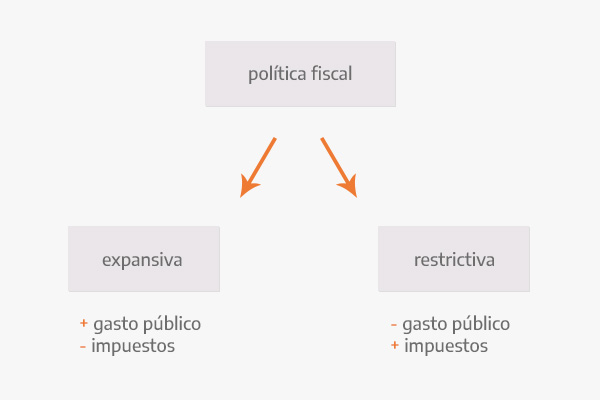
Fiscal policy can be expansive or restrictive.
Expansive fiscal policy
Expansive fiscal policy acts when the economy seeks to expand and achieves this by stimulating aggregate demand through certain resources, such as increased expenses, injecting money into the market and lowering taxes.
These mechanisms allow to increase production, reduce unemployment and generate greater consumption, which means promoting the economy.
However, this type of fiscal policy can have consequences, such as rising inflation.
Restrictive fiscal policy
When the economy reaches a point where inflation is high, restrictive fiscal policy slows aggregate demand, reducing public spending and raising taxes, in order to reduce it.
In this way, citizens reduce their consumption, lower inflation and avoid critical situations within the economy.
Objectives of fiscal policy
Fiscal policy was created based on specific and productive objectives, including:
- Successfully stabilize the economy and its cycle. For example, trying to stabilize exaggerated inflation.
- Increase the growth of the country through public spending, such as investments created for the benefit and economic growth of a people.
- Guarantee social services necessary for the population.
- Protect resources region of.
- Protect the population of the drastic changes and typical of the economic cycles.
Examples of measures in fiscal policy
In order to better understand this concept, we propose different scenarios in which fiscal policy operates:
- In a recession situation, it is very likely that a State applies an expansive fiscal policy to encourage consumption and achieve growth in the economy.
- A country that suffers from inflation and is at risk of hyperinflation You decide to apply a restrictive tax policy by increasing taxes, such as VAT and income tax.
- The restriction on imports and the distribution of resources among a nation, province or municipalities, are other measures imposed through fiscal policy.
Leave a Reply