
Elasticity of supply

What is the elasticity of supply?
The price elasticity of supply, or elasticity of supply, is the proportional change in the offer of a good or service divided by the proportional change in its price.
Elasticity allows us to analyze how sensitive a variable (in this case, supply) is to other variations (price).
There are several factors that affect these variables. Among the best known are the production costs (wages, machinery, etc.), the price from substitute goods (coffee and tea) or their complementary (sugar) and price of the good itself.
How to calculate the elasticity of supply?
The formula for calculating the elasticity of supply is as follows:
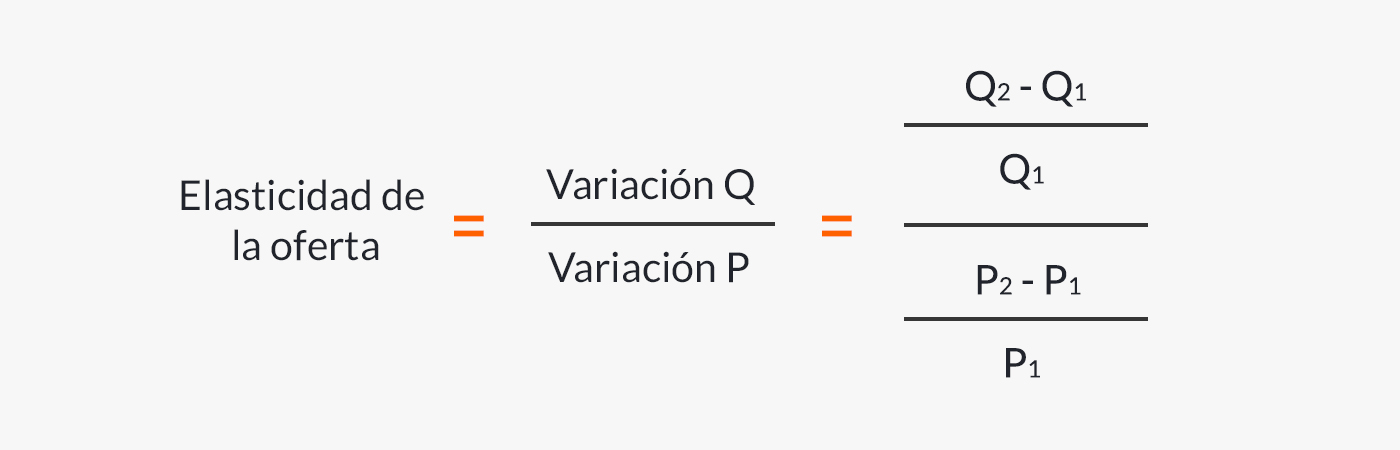
Formula for calculating the price elasticity of supply.
Where:
- Q₁ is the initial quantity supplied and P₁ the initial price.
- Q₂ is the final quantity supplied and P₂ the final price.
Types of elasticity of supply
Elasticities can be classified into:
- Elastic: A supply is said to be elastic when the proportional change in price produces a greater variation in the quantities supplied. (Elasticity> 1).
- Perfectly elastic: Supply is claimed to be perfectly elastic when a very low percentage change in price produces a very high percentage change in the quantity supplied. (Elasticity> 1).
- Inelastic: when the variation in the quantities offered is proportionally less than the variation that occurs in the price of the good. (Elasticity
- Perfectly inelastic- Occurs when only a certain amount of goods or services can be offered, regardless of price. For example, the sale of a property on the corner of a certain avenue. (Elasticity
- Unitary: changes in prices make the supply of goods and services vary in the same proportion. (Elasticity = 1).
Example of elasticity of supply
Given the increase in demand for food products in general, the company Alimentos SA has increased the quantity offered of its star product, from 10,000 to 15,000 units, raising the price from $ 150 to $ 175.
Applying the formula to calculate the elasticity of supply, we have:

Formula applied to the example.
Since 3% is greater than 1 (Elasticity> 1) it is said that the supply of this product is elastic: the proportional change in the price, caused a greater proportional change in the quantity supplied.
| Bibliography: |
|---|
|
Leave a Reply