
Elasticity of demand

What is the elasticity of demand?
The price elasticity of demand, or elasticity of demand, is the proportional change in the consumption of a good or service divided by the proportional change in its price.
Elasticity allows us to analyze how sensitive one variable (in this case demand) is to variations in another (price).
There are several factors that affect the quantity demanded and the price of goods and services. Among the most common are production costs (wages, machinery, etc.), the substitute goods price (butter and margarine) or the complementary (toast) and, of course, the price of the good itself.
How to calculate the elasticity of demand?
The formula for calculating the price elasticity of demand is as follows:
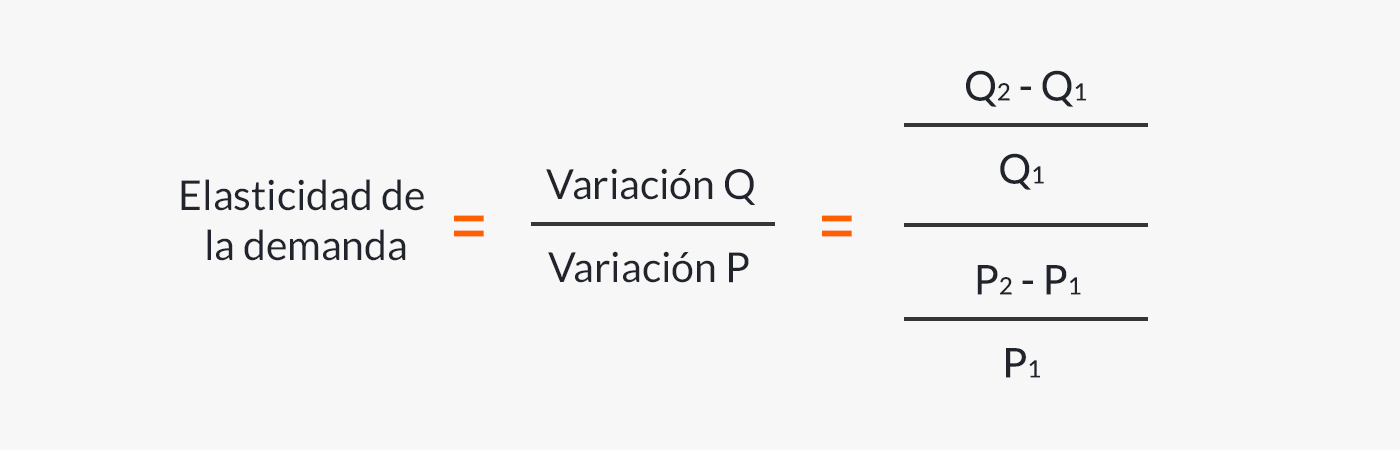
Formula for calculating the elasticity of demand.
Where:
- Q₁ is the initial quantity demanded and P₁ the initial price.
- Q₂ is the final quantity demanded and P₂ the final price.
Types of elasticity of demand
Elasticities can be classified into:
- Elastic: a demand is said to be elastic when the proportional change in its price produces a greater variation in the quantity demanded. (Elasticity> 1).
- Perfectly elasticSupply is perfectly elastic when a very low percentage change in price produces a very high percentage change in quantity demanded. (Elasticity> 1).
- Inelastic: when the variation in the quantities demanded is proportionally less than the variation that occurs in the price of the good. (Elasticity
- Perfectly inelastic: occurs when only a certain amount of goods or services can be demanded, regardless of price. For example, in the acquisition of an original painting by a famous painter. (Elasticity
- Unitary: when changes in prices make the demand for goods and services vary in the same proportion. (Elasticity = 1).
There is another classification of elasticity of demand:
- Cross elasticity of demand: represents the percentage change in the quantity demanded of a certain good or service, in the face of the price change in another substitute or complementary good or service. For example, if the price of fuel falls sharply, the quantity demanded of (add-on) cars is likely to increase.
- Income elasticity of demand: measures the proportion of the increase in the consumption of a good or service, as a consequence of an increase in the consumer's income.
Example of elasticity of demand
As a result of the increase in the inflation rate, the premium coffee company Cápsulas de Café SRL had to increase the price of its capsules from $ 95 to $ 115. This variation produced a change in the consumption habits of current customers: some began to purchase instant coffee and tea, which caused the quantity demanded of the product to decrease from 1,000 to 750 units per month.
Applying the formula mentioned above, we have:
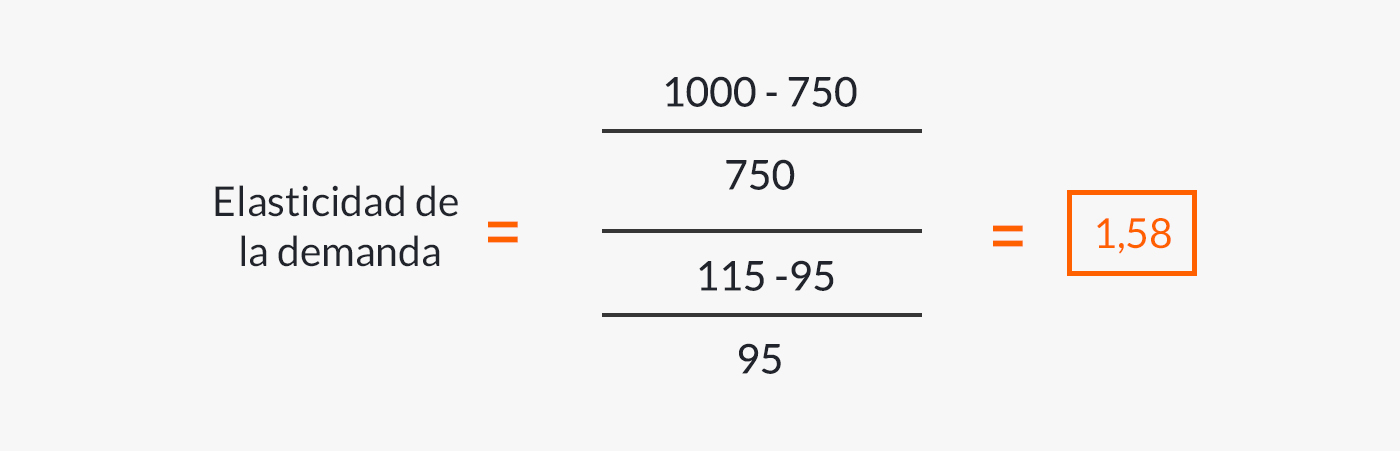
Formula applied to the example.
That the 1.58% elasticity is greater than 1 means that the quantity demanded of this product decreases in a greater proportion than its price rises.
| Bibliography: |
|---|
|
Leave a Reply