
Bill of exchange

Índice()
What is the bill of exchange?
The bill of exchange is a document that guarantees the payment of an amount of money, on a specific date and place.
In this kind of commercial document, a person, -librador or drawer-, orders another, -librado-, the payment of an amount of money within a certain period of time, previously agreed between both parties.
Thus, during this process three people participate:
- Drawer: Also known as drawer or subscriber, he is the one who issues the bill of exchange so that the drawee then accepts it.
- The rotated: drawn or paid, person in whose charge the document is issued; that is, who should pay it.
- The beneficiary: holder, bearer or taker, person in whose favor the document is issued; that is, who should collect it.
Characteristics of the bill of exchange
The characteristics of the bill of exchange are:
- Is fixed on itself, does not refer to other documents.
- Payment must be made at the due date.
- The payment mandate cannot be subject to conditions and obligations solidarity in nature.
- A series of requirements for the transaction to be considered valid.
- Can not be typing errors in said document, if so, it will be considered invalid.
Bill of exchange requirements
Among the requirements that the bill of exchange must have are:
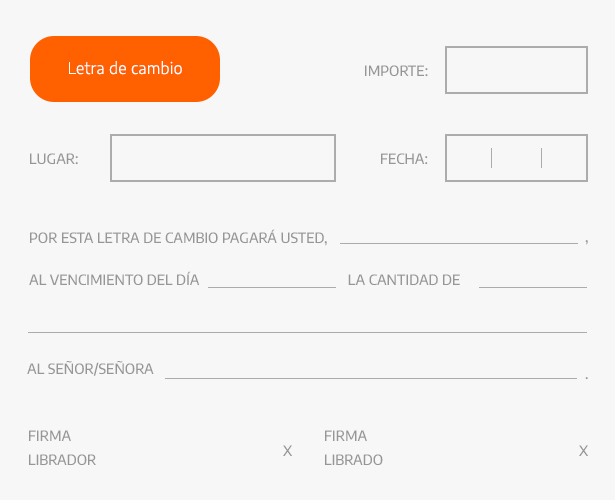
Example of bill of exchange and its components.
- Denomination: that it appears in said document that it is a bill of exchange.
- Order to pay (amount): the amount determined to be paid must be written in numbers and words. If necessary, the currency must be specified.
- Name and surname of the drawee.
- Due date: it can be of different types.
- On a fixed date.
- A term from the date.
- In sight.
- A term from sight.
- Place where payment must be made.
- Beneficiary's first and last name.
- Place and date of issuance of the letter.
- Signature of the issuer of the letter (spinner or rotated).
Bill of exchange rates
There are four types of bills of exchange, depending on their expiration date:
- On a fixed date: maturity is set to a certain date. That is, a specific date on which you must make the payment.
- One term from the date: expiration coincides with the time established in the letter. That is, the drawee will have a specific period to make the payment from the day after the bill is issued, which may be 15, 30 or 60 days, counting holidays.
- In sight: the expiration date has not been determined, but the payment must be made within one year from the date of acceptance, unless the drawer establishes the term.
- A term from sight: maturity is generated on the date of acceptance by the drawee.
Bill of exchange and promissory note
Among the main differences that we can find between bill of exchange and promissory note, the following stand out:
- In the case of the promissory note, two people: the one who agrees to pay the debt and the one who will pay it. In the bill of exchange, they participate three people: the drawer (issuer), the drawee (debtor) and the beneficiary (creditor).
- In the promissory note they admit interests, in the bill of exchange no.
- In the case of the promissory note, it is the transmitter who should be responsible for paying the debt, while in the bill of exchange it is the drawer who issues the document but the drawee is responsible for paying the debt.
- The promissory note represents a commitment and promise, instead, the bill of exchange is an obligation to pay a debt.
Go up
Leave a Reply