
VRIO analysis
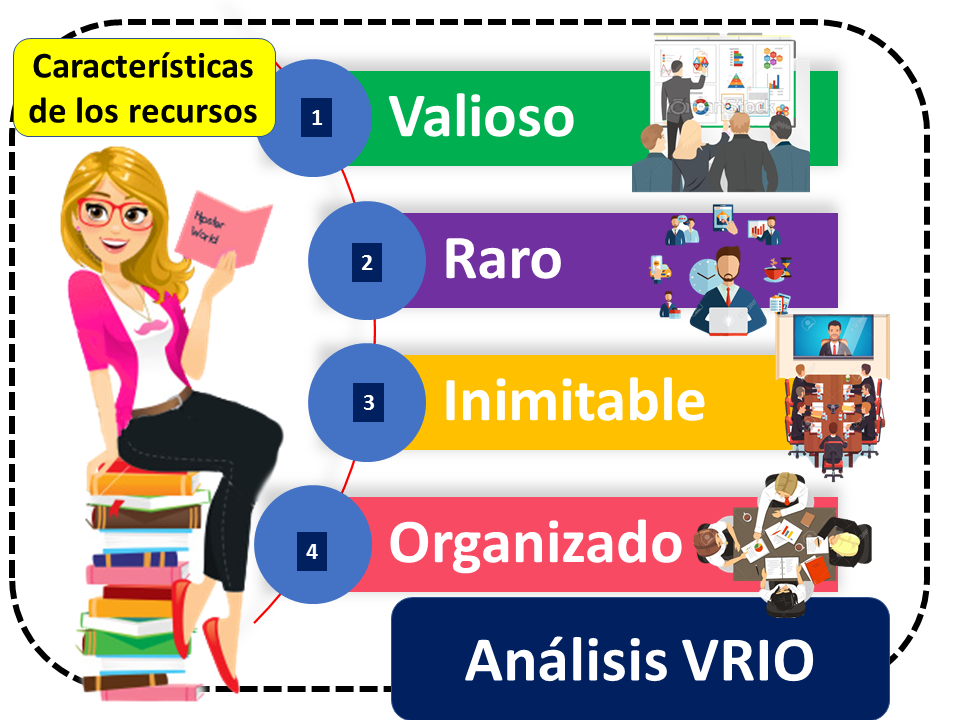
VRIO analysis is a tool used in the strategic analysis of a company. It allows you to determine which of your resources and capabilities can generate a competitive advantage.
Fundamentally, it is a tool that is very useful for companies because it allows you to notice what resources and capabilities you have. Then, by knowing how valuable, rare, inimitable and organized its resources and capabilities are, the company can develop a sustainable competitive advantage over time.
Indeed, for any company, developing a competitive advantage is very important. This, given that this advantage adds value and differentiation, which helps it to consolidate its position in the market.
Resource characteristics
Undoubtedly, the resources and capacities of a company have to meet certain basic characteristics in order to generate a competitive advantage for the company:
1. Valuable
First of all, a company's resources must have value. A valuable resource can help your business better cope with threats. Similarly, it helps you better seize and exploit your opportunities.
In short, the valuable is understood as the ability of the company to take advantage of business opportunities and thereby neutralize competitors.
2. Rare
Of course, the rarity of a material means that it is rare. The more scarce it is, the greater the advantage the company has. This will clearly depend on how many more competitors have the same resource. If only the company has it, this resource makes the company unique and distinguishable.
In general, a resource is rare if it is hard to find on the market. It can be a resource of specific use for the company. The rare determines if the company has control of the resource or in the hands of how many competitors are in control of it.
3. Inimitable
Now, that a resource is inimitable implies that it must be difficult to imitate. This makes the resource give a competitive advantage to a company. In other words, this characteristic means that competitors have little capacity to copy or replicate the resources or capacities of the company.
Furthermore, if the competitor wanted to copy said resource or capacity, this would incur very high costs. Therefore it is practically inimitable. It can also be considered (the inimitable characteristic) as the company's ability to offer something to the market that is difficult to replicate due to the high cost it represents for the competition.
4. Organized
On the other hand, the organization refers to the ability of the company to optimize the use of its resources and capabilities. This proper organization allows you to earn enough income to define your strategies.
In other words, if it is organized, the company has the capacity to take advantage of and efficiently exploit all its resources. The organization helps to know if the company has sufficient power to offer value and exploit its capabilities to the maximum.
What types of resources can be analyzed
The resources that can be analyzed in the VRIO tool are:
- Humans: Regarding human resources, the skills and level of knowledge possessed by the company's workers could be of interest.
- Financial: In this section, the company's own funds and access to external financing could be of interest.
- Materials: Among the material resources, the equipment, materials and tools that are possessed can be analyzed.
- No materials: Elements such as intellectual property and trademarks are of interest.
How to do the VRIO analysis
When developing a VRIO analysis we must consider the following:
1. Identify and define available resources
First, the resources available to the company must be identified. It is convenient that each identified resource be briefly defined. The resources that are listed can be human, financial, material and non-material.
2. Analyze the identified resources
Second, all identified resources must be analyzed. This will allow us to determine in each of the resources whether or not the company has an advantage.
3. View VRIO analysis
Third, the graph of the VRIO analysis is drawn up and the advantage or disadvantage of each resource can be easily visualized.
With each resource it will be possible to identify if the company has:
- Competitive disadvantage.
- Competitive parity.
- Temporary competitive advantage.
- A competitive advantage to exploit.
- Sustainable competitive advantage.
4. Interpret the results
Once the graph of the VRIO analysis has been prepared, it will allow all interested parties to observe the position of each resource, identifying the resources that offer the most benefits to the company. Likewise, it will be known which resources will have to improve their position so that they go from a lower level to a higher one.
Finally, a strategic plan must be prepared to optimize the competitive advantages that exist. You can also take advantage of new advantages that can be exploited, if they have not yet been taken advantage of.
Results and interpretation
With the analysis carried out, the materials can be classified as:
1. Not valued or not valuable
A resource that is not valued or is not valuable represents a competitive disadvantage for the company.
2. Valued, but not rare
On the other hand, if the resource is valuable, but not rare, it makes the company catch up with other competitors. This gives it a competitive parity, because it is on par with its competitors.
3. Valuable and rare
However, when the resource is valuable and rare, it can temporarily lead the company to competitive advantage. This means that you will be able to get high returns, but for a short period of time.
This is because competitors will be able to easily imitate this advantage, which will make it possible to find itself at competitive parity again in a short period of time.
4. Inimitable, valuable and rare, but not organized
When the resource meets the characteristics of inimitable, valuable and rare, but not organized, it will cause the company to have an untapped competitive advantage because it has not been exploited.
5. Organized, inimitable, valuable and rare
Finally, if the resource possesses the four previous characteristics (inimitable, valuable, rare and organized), the company has a sustainable competitive advantage. This allows you to have high profits and differentiate yourself from the competition, making you have a good position in the market.
These results can be seen in the following table.

In conclusion, it can be said that VRIO analysis helps companies identify the resources and capabilities they possess. In addition, these resources and capabilities help the company to differentiate itself from other competitors, giving it a competitive advantage that strengthens its position in the market. It can also help the company leverage resources and capabilities optimally.
Leave a Reply