
treachery

Treachery is a notion that, in the field of right, is used in reference to what an individual does to guarantee the realization of a crime against another subject without there being a risk to him. It is, therefore, a circumstance that aggravates the responsibility of the person who commits the crime.
Treachery is associated with acting on insurance. It involves the use of methods or means that ensure the crime by preventing the victim from being able to successfully defend himself or a third party from being able to intervene. That is why treachery is considered an aggravating factor when judging the fact in question.
It is common for the notion of treachery to be used when the victim is helpless and the offender takes advantage of said condition. Take the case of a sex offender who abuses a child. Due to his psychological and physical condition, the child finds himself in a situation of inferiority with respect to the adult: he is not in a position to defend himself. The attacker, in this way, guarantees the realization of the crime without risk. In this case, the abuse has the aggravation of treachery.
When the offender stalks his victim and ambush him, it can also be spoken of treachery. This happens if a kidnapper watches the movements of a person for several weeks to ensure that you can successfully capture it.
Another form of treachery is linked to the intention of hide the aggression not to be discovered. Suppose a man he poisons his partner to collect insurance by putting a few drops of a toxic product in his drink. Such action could be classified as treachery.
If we focus on doctrine penal classical, we will find that one of the most common examples of treachery that usually appears is the assassination of Julius Caesar: Marco June Brutus Cepion, generally known as Brutus, took advantage of his friendship with the Roman politician to carry out his plan to take his life, knowing that he would not suspect him. Precisely, he relied on the security provided by the trust that Julius Caesar placed in him to lead the conspiracy that ended in fatality.
With regard to the ways, instruments or situations in which a person can rely to guarantee the success of their future crimes, the doctrine distinguish the following three assumptions of treacherous murder, also known simply as assumptions of treachery:
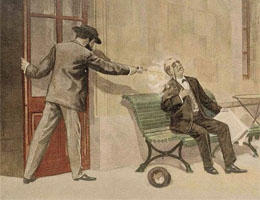
* treacherous or proditary crime: it is a crime that must be preceded by a process of observation, of cautious waiting (the stalking) or concealment, that is to say, that the offender hides for a time. The term proditory is defined as something that belongs to the treason, which includes it or is related to it, and that is why it is normal for this type of treachery to be appreciated in the homicide type of homicide;
* exploitation, when the victim is defenseless: As explained in previous examples, the criminal takes advantage of the impossibility of defending himself that his victim;
* insidious procedure: a crime that the author himself seeks to hide, to make it look like an accident. The most common example in this case is the use of poison to commit murder.
As a proper name, «Treachery»Is the title of an album and a song by Luis Eduardo Aute, a well-known Spanish singer-songwriter. It is a work that he wrote and published in 1995, in which they also worked Santigo Feliu Y Silvio Rodriguez. Aute is a musician of international fame, although he also owns other talents and has explored other areas, such as acting, poetry and film directing.
Leave a Reply