
siege
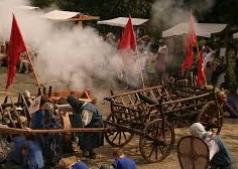
It is called siege to the act and the consequence of besieging. This verb, for its part, refers to press insistently or fence or surround a certain place to somehow harm those who are in it.
Siege is the name given to the military action which consists of blocking a fortress or city for an extended period and then proceeding to its assault. The siege prevents supply, causing wear and tear on people.
Suppose a military force X intends to conquer a city Y. The enemy side takes refuge in this town, ready to resist the advance. Military force X, in this way, carry out a siege of the city Y- Places your troops, tanks and other vehicles in your surroundings, preventing people from entering or leaving. Days later, in the city Y the food, medicines and other essential goods. Military force X, seeing his enemy weakened, he proceeds to carry out the assault.
It is often said that the military siege can generate four situations. When the attackers manage to enter the city and capture or eliminate the defenders, the drop of the besieged place. If the attackers enter but the defenders flee, the city is evacuated. In the event that the defenders manage to resist the siege without outside help, the city retains its position. Finally, when advocates are successful with outside support, they achieve get up the siege.
This measure by an army arises as a result of not being able to get the opposing side to surrender. When combining a situation of this type, which usually results in a waste of time and resources, with the difficulty of taking the fortress or the city by means of a frontal assault, the siege seems to be the most effective decision.
To achieve the weakening of the enemy by means of this tactic it is usually necessary to surround the terrain and use the so-called siege weapons to get the supply lines blocked.
The siege weapons, also known as siege machinery, are those that in ancient times were used to overcome or demolish walls, fortresses, forts and castles effectively in the context of a siege. Its use not only saved time, but also increased the chances of success. Its creation aimed to overcome every obstacle that stood between the attacking army and the attacked one.
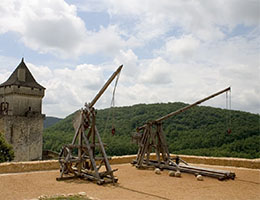
The list of siege weapons is extensive, and the oldest on the European continent is the ram, thanks to which it was possible to destroy fortified walls and gates. Its most rudimentary form is a simple trunk large and heavy, which had to be carried by many people and propelled against the target. However, throughout history, designs of varying complexity appeared that included wheels and a roof to protect the ram from fire attacks.
In ancient Greece appeared the catapult, another of the siege weapons that have transcended and today are part of a myriad of works of fiction. Thanks to its design, the catapult was used to launch large and heavy objects against enemy buildings. The Carthaginians and Romans made numerous improvements to it, and it was widely used during the Middle Ages.
With regard to the siege, in Europe it was one of the fundamental resources of the war throughout the Renaissance and the Modern Age. In fact, the own Leonardo da Vinci he designed many fortifications that earned him much of his recognition.
"The siege", finally, is the qualification from a novel written by Spanish Arturo Pérez- Reverte. The book was published in 2010.
Leave a Reply