
reflex action
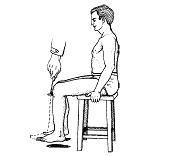
A reflex action it's a involuntary movement what a person perform as answer before a certain stimulus. These movements are controlled by the reflex arc: a series of structures that act as an intermediary between the sensory receptor and the effector.
It is necessary to differentiate, therefore, between the reflex act (a action involuntary and stereotyped) and the reflex arc (the structures that drive the performance of the reflex act).
Let's see a brief definition of some of the complementary concepts of reflex action, in order to understand its use in this context:
* sensory receptor: it is a nerve ending found in the ear, tongue, nose, eyes and skin, among others sensory organs. It is in charge of receiving external and internal stimuli, and then transporting the data and get an answer in the form of sensations and nerve impulse. This impulse is then taken to the central nervous system, where it is processed so that the individual obtains information about the characteristics of their environment and can respond appropriately;
* sensory neuron: also called sensory neuron, and it is the one that is responsible for converting any external stimulus into an internal one. Its activation takes place through the action of senses, and sends projections to the central nervous system for the subsequent transmission of information to the spinal cord or brain. A fundamental difference between this type of neuron and the one that we can find in the central nervous system is that the former receives stimuli such as sound, temperature or light, and not from other neurons;
* integrating neuron: also known as interneuron, is part of the central nervous system, its size is small and its axon (a prolongation whose length determines the type of neuron) is short. The interneuron does not connect with muscle fibers or sensory receptors, but does so exclusively with other neurons, and this allows it to carry out functions of great complexity;
* motor neuron: Another fundamental concept for the understanding of the reflex act, since it is the type of neuron directly involved with the movement and locomotion of vertebrates. When transmitting a nerve impulse, the muscle cell recognizes the sign thanks to the presence of receptors, which generate a response;
* effector: it is a nerve cell that produces a response each time it receives a stimulus. Some of the most common are secretion of some substance and, essential in the case of the reflex act, movement.

Each reflex action involves the coordination of three stages at high speed: the excitement, the driving and the reaction. The whole process begins when the receptors capture the nervous stimulus, which is conducted through the reflex arc towards the effector for the development of the answer.
In other words: the nervous stimulus produces an excitation (the first stage of the reflex act), which motivates the conduction (second stage) of the message towards the spinal cord. This nervous tissue is responsible for the coordination of the response, which develops as reaction (third stage).
According to the classes of neurons involved in the reflex act, it is possible to distinguish between the simple reflex acts and the compound reflex acts. In simple reflex acts, only two neurons act: the sensory neuron and the motor neuron. In compound reflex acts, on the other hand, an intercalary neuron is also involved, mediating between the sensory and the motor neurons.
A example typical reflex action is the movement that we do when we receive a blow to the patellar ligament (in the knee area) and, involuntarily, we lift the leg.
Leave a Reply