
oleander
The Greek word dáphnē, which can be translated as "laurel", came to classical Arabic as diflà. East finished, in turn, derived in Hispanic Arabic addífla, which is the direct etymological antecedent of oleander.
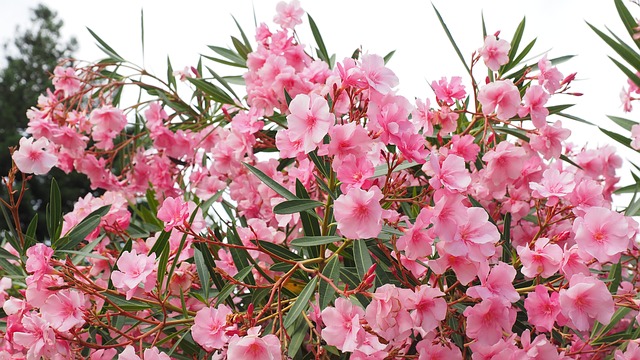
The Royal Spanish Academy (RAE), in its dictionary, indicates that oleander is a bush that is part of the family group of apocinaceae. It is a poisonous plant whose leaves resemble those of the laurel, also having grouped flowers that can have different shades.
The species Nerium oleander is known as oleander.
Oleander characteristics
The oleander, whose scientific name is Nerium oleander, is also known as laurel rose, flower laurel, roman laurel, trinitarian or baldness. The species was described by Carlos Linnaeus on 1753, in his famous work "Species Plantarum".
Native to areas such as Mediterranean, Vietnam and China, oleander has been introduced in numerous countries since it is used as ornamental plant. In addition to being grown in gardens, it is often used on highways and roads to separate lanes.
Capable of reaching a height of up to four meters, its leaves their nerves are extremely marked. The flowers have reddish calyx and sharp, lanceolate lobes.
Toxic components
Because it has different components of high toxicity, oleander is mentioned as a poisonous plant. If extended contact is maintained with your sap, it is possible to develop a dermatitis or suffer eye problems.
Ingesting a large amount of oleander, on the other hand, can cause an alteration of the heart rhythm, pain in the abdomen, nausea, diarrhea and vomiting. The most toxic compounds are concentrated mainly in the estate, followed by the leaves and stems.
Cattle are often poisoned by eating oleander. This happens with sheep, goats, cows and horses, for instance. It is interesting to note that there are insects that can feed on this shrub without suffering negative consequences: that is the case of the oleander sphinx, a lepidopteran with a scientific name Daphnis nerii.
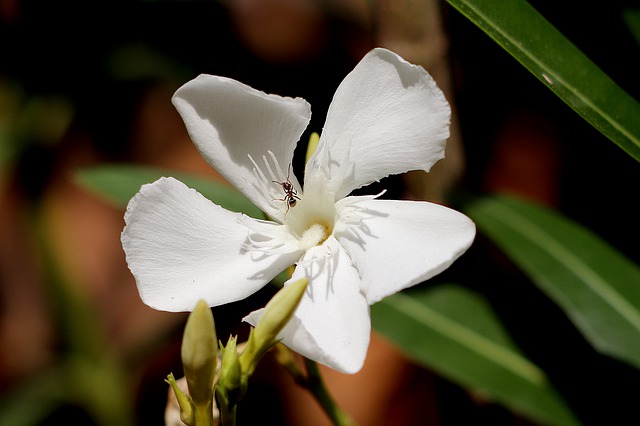
Oleander flowers can be different colors.
Other plants called oleander
It should be noted that the Nerium oleander it's not the only one plant known as oleander. The Epilobium hirsutum, a herbaceous species, can be referred to as small oleander, oleander, hairy oleander, oleander, hairy willowweed, St. Anthony's wort or Saint Anthony laurel.
It's also called oleander, tears of mary or Maria's heart to Zephyranthes carinata. The Euphorbia mellifera, meanwhile, is called oleander, wild tabaiba, tabaiba from mountain or filga.
A woman's name
On Spain, Oleander is a feminine name. We can mention Oleander Soro, a Dominican nun, martyr and blessed born in 1887 and killed in 1936 within the framework of Civil war.
The actress Bald Oleander, for his part, achieved fame thanks to his work in series such as "The secret of Puente Viejo", "The Money Heist", "Toy Boy" and "The Ministry of Time" and in films What "Orange honey", "The author", "The minimal island" and "The summer we live in".
Play "Las adelfas"
On 1928, at Theater The Golden from Barcelona, a play entitled "The oleanders", written by the brothers Antonio and Manuel Machado. That staging had Lola membrives, Luis Roses, Guadalupe Muñoz Sampedro and Manuel Soto Vives as protagonists.
The central character of "The oleanders" is the Duchess of Tormes, a woman named Araceli suffering from nightmares related to her dead husband. Faced with this situation, he goes to a doctor friend and begins to talk with different persons that they treated her husband, discovering details of the deceased that they did not know.
Leave a Reply