
Old regime
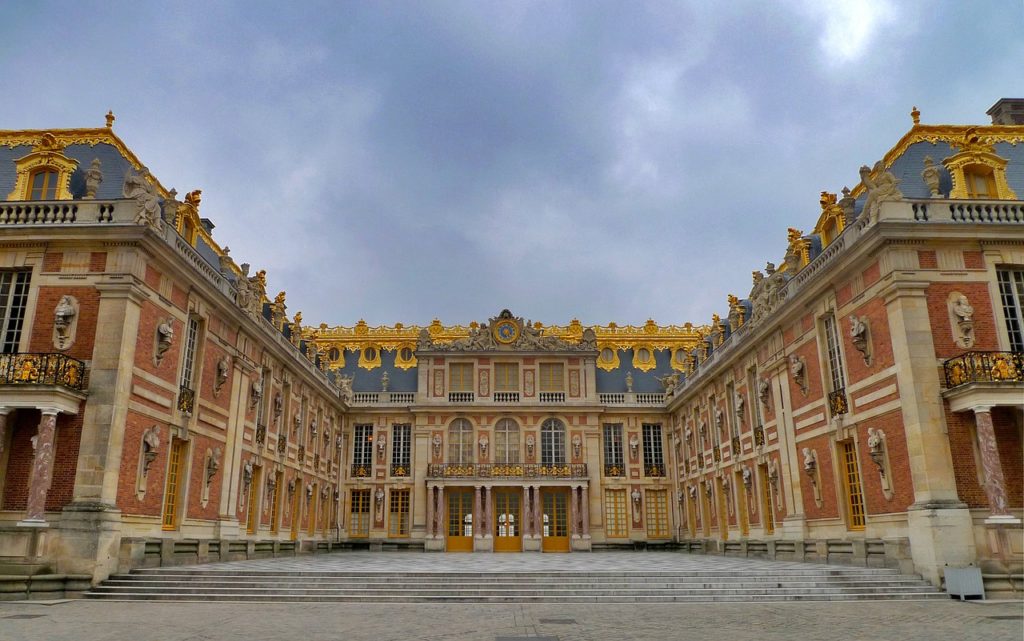
The Old Regime was the form of government used in France, and in much of Europe, during the seventeenth and eighteenth centuries. It has very particular economic, social and political features, the end of which was precipitated after the French Revolution.
In addition to its form of government, we speak of the Old Regime to refer to a time situated at the end of the Modern Age. And that, in addition, it has peculiar characteristics in terms of its social and economic relationships.
The end of the Old Regime came with the French Revolution, whose last king was the Bourbon Louis XVI, publicly beheaded by the guillotine, the insignia of the revolution. End accelerated by the bad government of the king during his years in office, who did not know how to solve the ills of his citizens.
The term "Old Regime" was first coined by the French revolutionaries. This to refer, in a clear derogatory way, to the form of government prior to the outbreak of the revolution of 1789.
Politics in the Old Regime
The form of government was the absolute monarchy, characterized by the mandate of a king. Thus, the king treasured the three powers (judicial, legislative and executive). His regime and throne were of divine inspiration, chosen by God to carry out the position of king. Furthermore, justifying himself in this regard, his power had no limits, he imparted his government in a despotic way; and justice arbitrarily. Although, due to the role of the nobility, some kings did have certain unwritten limits.
Some countries had parliaments, although their role was often to legitimize the king. Although, in some cases, they came into conflict with the monarch; who accepted the parliamentary refusal or, on the contrary, subdued it and finally imposed himself.
It should be noted that the Old Regime also coincides with the Enlightenment, a period known as enlightened despotism. Government by which the monarch established reforms in favor of the common people, but without their participation.
Society in the Old Regime
The prevailing social stratification in the Old Regime was the estate system. Characterized by the existence of three estates, whose mobility was very complicated although it was not regulated by law. The estates were the following:
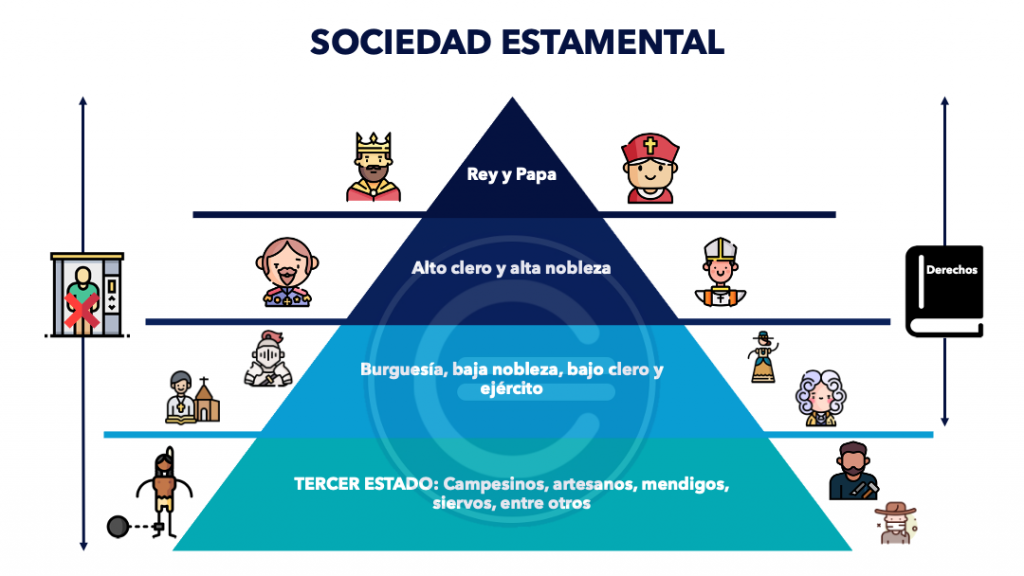
- Nobility: A distinction is made between the king and the rest of the nobles. The latter were vassals of the monarch, who swore allegiance and contributions according to the established pacts, in exchange for maintaining their nobility status.
- Clergy: It was made up of all the members of the Church, therefore, they had a series of privileges. They are below the nobility but above the common people.
- Third estate: Internally, as in the nobility, there are two divisions. On the one hand, the merchants and artisans; and on the other, the peasants, in a more precarious situation than the previous ones.
This last stratum accounted for more than 95% of the population, subdued by the other 5%. This situation, plus the grievances of government mismanagement, led to the French Revolution and the fall of this system, replaced by social classes.
Economy in the Old Regime
The economy of the Old Regime was based on two engines: agriculture, which was the main activity; And trade.
There were two forms of organization on the farm. On one side was the village, which was made up of the families who worked the land, this being the one in charge of organizing the work and the lands that were dedicated to cultivating and grazing animals. On the other hand, trade, which grew during the 18th century. Europe imported a large amount of food from its colonies, and within its national territories the textile industry was promoted.
This boom in trade was the driving force behind the industrial revolution, which began in the United Kingdom and gradually exported to the rest of Europe.
End of the Old Regime
Historically, the event that ends this era is the French Revolution. Who tried to undermine all facets and vestiges of the previous order.
Faced with the discontent of the French population by the famines and the crisis that the country was experiencing, added to the ostentatious life that the royal house led, the French decided to put an end, and in a violent way, with the monarchy and its political and social order.
A new epoch arose from it: the contemporary age. A new era, which continues to this day.
Leave a Reply