
musical accent
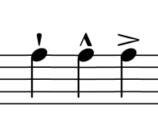
Accent, which derives from the Latin accentus, is a concept with several uses: it can be the intensity which is applied to a certain syllable in pronunciation or Energy or relief that is used in certain words, topics or interests. Musical, on the other hand, is what is linked to music (the combination of rhythm, harmony and melody).
The idea from musical accent, therefore, is related to emphasis applied in a chord or in a note. The use of the musical accent determines the accentuation, one of the issues involved in the way the compositions are expressed.
The musical accent is perceived in the ear as a particular application of Energy, made possible by a way of interpreting a musical phrase. This accent is specified in the notation through a sign that indicates to the interpreter the need to apply more intensity in that note, compared to the rest of the notes that are around it.
The importance of the musical accent is as great as that of any other element of a composition, including each note of the various melodies that make it up, since if the interpreter ignores the accent then he cannot reproduce the work correctly. This is the key to articulating a performance: accented notes stand out from the rest and allow a harmonious pattern to be generated in the ear; on the contrary, it could be said that without a musical accent, any melody would be a straight line.
When a musician is about to learn a work to perform with his instrument (this includes the voice), among the steps prior to the first performance is the identification of the rhythm, that is, the way in which the bars are arranged; this information also contains the skeleton of accentuation. In a two-quarter measure, for example, we know that the first half should be played with more intensity than the second; Of course, subdivisions increase the complexity of the stress, since in each half there may be more than one note, irregular groups or rests.
This responds in part to the concept of metric accent, one of the recognized accent types in music theory. Thanks to this characteristic of the rhythmic organization, it is possible to concretize the metrics of the compositions, so that each person who reads the same score can execute it in the same way, saving decisions of an interpretive nature.
The accent should always fall on the first time of a compass; on the other hand, in many cases there is a subacent which must be played at the beginning of each beat. This can be seen very easily in the quaternary time signature, that is, in those that are divided into four beats, such as that of four rooms. In this case, the third beat should be accentuated more than the second and fourth, but less than the first; In other words, and according to the great theorists, it is a time semi-strong.
The tonic accent, for its part, is an emphasis that is applied to a note so that it has more intensity those that surround it. Unlike the metric accent, it is not linked to the basic structure of a composition, so it is not mandatory to use it; on the contrary, it is a resource of interpretation, which may or may not indicate the composer in the original score. Without this type of musical accent it is very difficult to bring a work to life, since it serves to break with the "perfection" to which the tonic accent leads and is ideal for merging music and text.
It should be noted that the musical accent has its opposite: the anti-accent. In this case, common in percussion, the note should be played more softly than the others.
Leave a Reply