
liturgical year
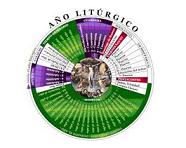
Before entering fully into the clarification of the meaning of the term liturgical year, it is essential to know the etymological origin of the two words that shape it:
-Year comes from Latin, exactly from “annus”, which has the same meaning as in Spanish.
-Liturgical, on the other hand, it is a term of Greek origin. Specifically, it comes from “leitoyrgikos” which can be translated as “related to religious ceremonies”. It is the result of the sum of three clearly differentiated parts: the noun “leiton” (government house), the element “ergon” (work) and the suffix “-ico”, which is used to indicate “relative to”.
A year it's a time period that spans twelve months. Usually the notion is associated with the calendar year, which begins on the day January 1 and ends the December 31st. However, there are different kinds of year according to how time is measured, which can even be less than or more than twelve months (such as the school year).
In the case of liturgical year, Its about Name that receives the year that governs the festivities of the Christian Church, whose beginning is in the initial Sunday of the Advent (that is, on the first Sunday of the liturgical season preceding the celebration of the Christmas; said time has an extension of four weeks).
The liturgical year, in this way, organizes the various liturgical times that are linked to acts of worship, which in turn derive from the Bible. The faithful, following the liturgical year, can know what prayers should be said at each moment and know what colors the celebrant of the rite will wear in the liturgy.
In addition to all the above, we cannot ignore that for Christians the liturgical year has two clear functions:
-On the one hand, a salvific mission, insofar as they receive during that period the grace of the intimate joy of salvation, that of Christian hope, courage and bravery, the conversion of the heart ...
-On the other hand, it is established that this liturgical year has a catechetical objective. Yes, because, through it, the mysteries of Christ are learned: Christmas, Epiphany, Death, Resurrection ... Thus, for example, at Christmas the birth of Jesus Christ is commemorated while at Easter they choose to do the same with the passion, death and resurrection of the same.
Although there are celebrations whose date is fixed every year (such as the Christmas, which is celebrated on December 25th), others change (such as Easter). The liturgical year has particular relevance in these cases, when the celebrations are mobile and it is necessary to keep in mind when they are celebrated each year.
It is important to know that the liturgical year has two cycles: the Christological temporal, which is the one that revolves around Christ and the saints. The latter is the one dedicated to the saints and the Virgin.
If we focus on the Roman Apostolic Catholic Church, the liturgical year is made up of the Ordinary Time, the Advent season, the Christmas time, the Lenten season and the Easter time.
Leave a Reply