
Lineage
Abolengo is a term that refers to a person's ancestry, especially grandparents. At the legal level, it refers to the goods received by the ascendants always free of charge.
This concept is applied in legal terms when speaking of inheritance law or inheritance law and gift law.
It refers to the assets and rights inherited by the ancestors (especially grandparents) or donated by them.
Characteristics of ancestry
The main characteristics of ancestral goods are:
- The expression of ancestral goods is not commonly used, but this term was well known and used in the Middle Ages.
- The knowledge of this type of property dates back to the high Middle Ages and constituted the gross of inheritance and family assets, understood as untouchable own assets.
- They are the assets, rights and debts acquired free of charge. Therefore, they can be acquired by donation or inheritance.
- If the goods come by inheritance, only those that come from ancestry are ancestral goods. More specifically, second degree of consanguinity.
- The heirs of the ancestral assets are forced heirs.
- The ancestral property, unlike the property inherited by a third party who was not an ancestor, had restrictions in the law of the Middle Ages. That is, limitations were placed on their alienation as a method of the permanence of the family lineage.
Hereditary ancestral assets
The inheritance can come to a person in several ways, inheriting through collateral, ascending or descending. The ancestral assets are the assets inherited only by the ascendants.
To better understand ancestral goods, first we will see how they are received and what degree of consanguinity is through which they are received.
Only when the inheritance comes by second or first ascending degree, there is the definition of ancestral assets. Therefore, observing the following table, only ancestral assets can be inherited by parents and grandparents (first and second degree of consanguinity).

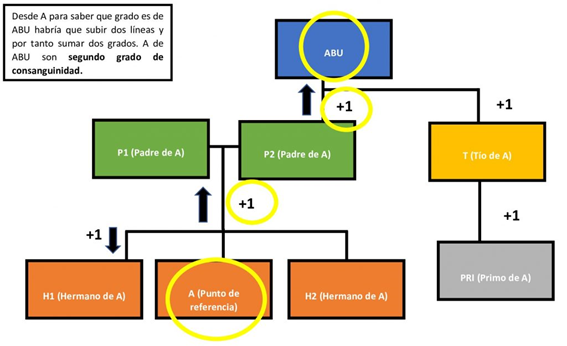
The only way to inherit ancestral assets is vertically (not collateral) and only by ancestor (not by children), here we have an example of second degree of consanguinity:
Leave a Reply