
Free amortization
Free amortization consists of the power that the tax agency of each country grants to a company to decide the rate of depreciation of its fixed or real estate assets, regardless of the amortization coefficients that it issues annually.
Otherwise, it is an option that allows the company to amortize its assets in a more realistic way, depending on the use they give it. Thus, from an accounting point of view, a computer cannot be amortized in the same way as a machinery, since their depreciation is different. There are goods that lose value more quickly than others.
Free amortization. Accounting and taxation
Companies are obliged to write off their fixed assets, for example their building or their vehicles. From an accounting point of view, this must be consistent with the loss of value due to its use. However, the Treasury of most countries issues tables of linear amortization coefficients every year. The free depreciation option allows them to post depreciation based on usage and not on these tax indications.
Thus, the company can choose the amortization method that best adapts to reality and offers a true image of its economic-financial structure. On the other hand, you can also carry out tax planning appropriate to your interests (as we will see in the example), within the current legislation. In addition, it allows you to know the true value of the asset at a given time as the difference between its acquisition price and depreciation.
Examples of amortization differences
Let's imagine we have a machine that makes a certain product, for example headphones. In turn, we know what its average annual production is, for example, 100,000 units and the supplier informs us that it usually has the capacity (use) to manufacture 1,000,000 pieces. On the other hand, the Treasury believes that in this case it should be amortized 20% per year. Its acquisition price is € 100,000. Let's see how it would be calculated:
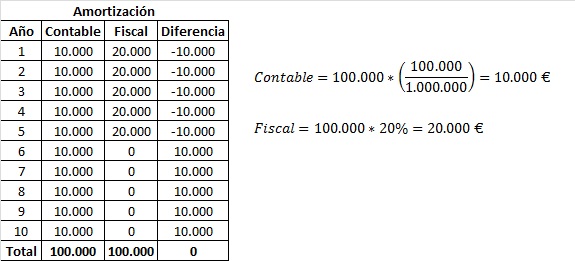
We can see that the accounting and tax calculation formula is simple, but in the first one the amount to be amortized annually is half. When making the table we see that there are a series of differences between both methods each year. The first five, we amortize less amount for accounting than for tax purposes, that is, we record € 10,000 but the Tax Agency allows us to deduct € 20,000.
As this item is an expense for us, we are going to deduct the € 20,000 because that way, we will pay less taxes in those years. However, in the following five years the opposite situation occurs and we will pay more taxes. At the end of the true useful life, ten years, some differences will be compensated with the others. We are really only deferring the payment of taxes, something that can benefit us in certain circumstances.
Leave a Reply