
Economic agent

An economic agent is any natural or legal person who participates in some way or in some part of the process of an economic activity.
We call an economic agent any of the parties that make economic activity possible. Thus, within economic activity and the economic process in general, we can meet different agents. These agents can participate or make decisions in the form of producers, consumers, savers or even investors.
The word economic agent is a word widely used in economic theory. Thus, in everyday language it is not used as often. At this point, we must not confuse homo economicus with an economic agent. The first, according to its definition, is characterized by a series of aspects, among which it stands out that it is rational and maximizes its utility. The term economic agent is neutral, so an economist can use the term under different assumptions if he wishes. Thus, it can determine both that the agent is rational and the opposite.
What are the economic agents?
In general, we could speak of economic agents individually or in a general way. For example, in an equilibrium model, one agent could be a buyer and another could be a producer. Now, in general, economic science tends to divide between four economic agents:
- Households: Both families and those who live alone but make economic decisions are part of it. Decisions that can be to consume, work for yourself or someone else, even save and invest.
- Companies: They are all those legal persons that carry out an economic activity, regardless of whether said activity is for profit or not.
- Condition: It usually tries to act as a regulator and tax collector in the economy.
- Central banks: Central banks are another essential economic act or agent.
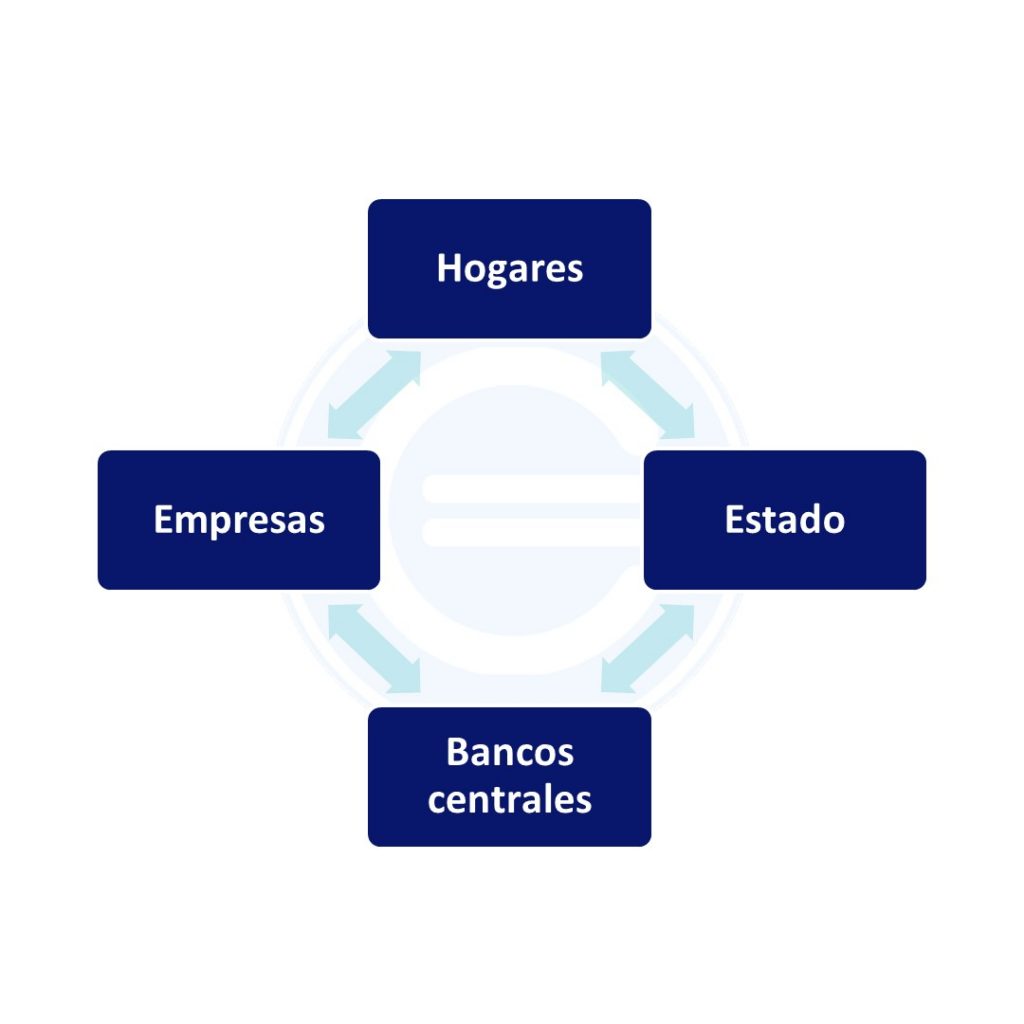
Traditionally, central banks were not included in the economic agents, but the importance they have acquired during the last decades has transformed them into a very relevant economic agent. On the other hand, within companies we could divide, for example, into cooperatives, associations, non-governmental organizations or foundations. Likewise, we could also subdivide homes and pay special attention to the State. Regarding the latter, it would be possible to discern whether, in each case, the central bank of each country or region depends on one or more States.
For example, in certain countries the actions of the country's central bank depend on the government. In other countries, however, they are assumed to be independent by law and, at the same time, by being part of monetary unions, there are central banks with greater power. It would be the case of any country of the Monetary Economic Union (EMU).
Another classification of economic agents
Although the generally accepted and used division of economic agents is the one mentioned above, it is not the only one. Another possible classification would be one that divides based on performance. A company can be both a buyer, a producer, a seller, a saver and an investor. The same happens with a worker, he can be both a buyer, a seller, a producer, a saver and an investor.
Economic dynamics have evolved over the last century so rapidly that economic agents are not necessarily anchored in one part of the activity. For example, a worker in a certain company who saves part of his money and also invests it in other companies is contributing to the economic process. This is relatively easily seen in the simple but illustrative model of the circular flow of income. This model represents a scheme that relates the different agents.
In short, whatever the adjective we use, an economic agent is anyone who participates in the economy.
Leave a Reply