
constant acceleration

To understand the concept of constant acceleration, it is necessary that we first know clearly what each of the words that make up the expression refers to. Acceleration, which comes from the Latin word acceleration, refers to the act and result of accelerating (increasing speed, granting speed). Constant, for its part, is what has constancy (perseverance or certainty).
Based on these definitions, we can now move forward with the idea of constant acceleration. For acceleration to exist, a Body should change your scrolling speed. Acceleration reflects how velocity changes over a certain period of time.
Suppose a car traveling at 100 kilometers per hour achieves, ten minutes later, a speed of 120 kilometers per hour. Said vehicle had an acceleration of 20 kilometers per hour in a period of ten minutes.
It is impossible to maintain constant that acceleration since, by increasing its velocity on 20 kilometers per hour every ten minutes, the car would soon reach its top speed (it couldn't go faster). In addition, a motorist can never increase his speed constantly (that is, apply a constant acceleration to the vehicle) since he must brake to avoid hitting other cars or to avoid going off the road in a curve, for example.
The speed, which reflects how much weather it takes to travel a distance, yes it can become constant. A person walking along the beach at the same pace is likely to maintain a constant speed until you decide to stop.
To find cases of constant acceleration, we can refer to an object in free fall, whose speed can increase until it reaches the surface. The acceleration involved in this case is the force of gravity, which constantly modifies the speed of the body, causing it to fall towards the ground faster and faster. A formula general that we can use to find out the position on the axis Y of a body in constant acceleration can be seen in the second image.
This can be studied from the complexity of physics, to analyze various phenomena in a complementary way, but it can also be applied in areas other than science, such as animation. In a cartoon, a CGI movie, or a video game, for example, applying physics concepts is necessary to create credible scenes, especially if the content focuses on the action.
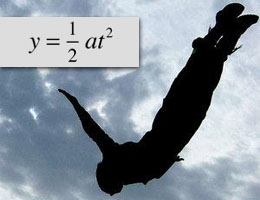
When a character jumps, there are two main phases of his animation: his increase in altitude, which is limited by various factors until the force that drives it up is canceled; its descent, where the concept of constant acceleration can be appreciated precisely. The same happens if it is dropped from a structure, since the force of gravity will modify its speed in each frame until the body collides with the ground and the fall stops.
Free fall is an example of the uniformly accelerated rectilinear motion (whose acronym is MRUA), which is also known as uniformly varied rectilinear motion (or MRUV); It is a phenomenon of physics that describes the displacement of a mobile along a straight path while it is exposed to a constant acceleration.
It is important to note that MRUA is one of the special cases of the so-called uniformly accelerated motion (MUA), which is defined as follows: any movement that leads an object to undergo acceleration and maintain its direction and magnitude constant over time, without losing firmness.
Besides the freefallAnother example of motion in which constant acceleration is seen is that of a particle that leaves rest to begin to submit to a constant force that accelerates it.
Leave a Reply