
cistern

The concept of cistern comes from the Arabic language and refers to a tank, according to the first meaning collected by the Royal Spanish Academy (RAE) in your dictionary. A cistern, in this way, is a water reservoir which is installed underground.
In general, the cisterns allow the storage of drinking water. Its structure appeals to materials that prevent the water from becoming contaminated and that prevent leaks from occurring.
The wells arose at the time of the Ancient Rome. In those more arid lands, deposits began to be built under the land to store the water from the rainfall. In this way, when there was no rain, this water could be used to irrigate crops, cook or for other purposes.
With the running of the story, the structures of the reservoirs were modified so that these devices were increasingly efficient. Many houses began to have their own wells, from where the inhabitants obtained the water they used in daily life.
To extract the water from the cistern, a pulley system. These simple machines make it possible to transmit the force: the person pulls a rope that has a bucket tied to the other end and thus can lift and remove the water.
It is important to note that the cistern must receive a certain maintenance to ensure water quality and to protect the structure. It is necessary to proceed with the disinfection and the elimination of sediments with a certain frequency.
To prevent the transmission of disease Due to the consumption of dirty water, either for drinking or for other purposes, it is necessary to empty, clean and disinfect the cistern at least once a year. There are specific regulations to regulate the maintenance of the reservoirs, so it is not an option, but an obligation.
Although in a private house it is possible to skip cleaning the cistern, or not carry it out with the frequency set forth in the previous paragraph, in neighboring communities the situation is very different, especially if there is no other source of drinking water. One of the most common problems is accumulation of water for too long, which can adversely affect its quality.
Among the products necessary for cleaning a cistern is the disinfectant, ideal for completely eliminating fungi and bacteria. At the bottom of the well, traces of sand, copper, stone, lead and other solid particles that come from the well tend to accumulate. net.
In Spain, to cite a specific example, the regulations suggest that the cisterns and water tanks be completely emptied once a year and that the following tasks be carried out:
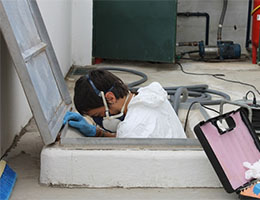
* sludge cleaning;
* treatment against microbes and disinfection;
* studies to determine the potability of the water and the detection of bacteria known as Legionella, which live in stagnant waters, especially above 35 ° C, and can cause infections in our body;
* maintenance of the circuit that crosses the water to the cistern and from it to the houses.
To protect the water in the cistern from contamination It is essential that: the terrain on which it runs does not present any pollutant; the pipes are cleaned with some frequency; there is a system that drains and decants the water before entering the cistern, to avoid the presence of particles of considerable size; make sure that sunlight does not reach the interior of the tank, so that algae does not grow there; extract the water by means of pumping.
Leave a Reply