
anadiplosis
Before entering fully into the establishment of the meaning of the term anadiplosis, we have to establish its etymological origin. In this case, we can determine that it derives from Latin, from "anadiplosis". One word is that, in turn, comes from the Greek "anadiplosis", which emanates from the verb "anadiploo". This can be translated as "double" or "reduplicate".
The anadiplosis is a Figure of speech what does the repetition of a word at the end of an expression or a verse and at the beginning of the next. The resource is also known as conduplication. If the figure it is reiterated in several verses or expressions, it speaks of concatenation.
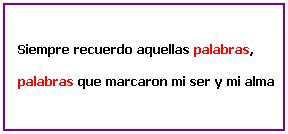
For example: "I always remember those words, / words that marked my being and my soul". As can be seen, the term "words" appears both at the end of the first verse as in the beginning of the second verse. This literary figure is an anadiplosis.
It is possible that, in the following verses, the sequence of anadiplosis generates a concatenation: “I always remember those words / words that marked my being and my soul. / Soul tortured by pain and betrayal, / betrayals that, like knives, tore me apart ". The last word of the first verse"words") is repeated at the beginning of the second, whose last word ("soul") starts the third. The closing of this third verse ("Betrayals"), in turn, leads the fourth and last verse.
A example of anadiplosis and concatenation can be found in "Songs", A song of Joan Manuel Serrat about verses of Antonio Machado. In the first stanza, the last three verses feature anadiplosis: "... but our thing is to pass, / to pass by making paths, / paths over the sea". The terms "happen" Y "roads" they are found at the beginning and at the end of the verses.
As in "Songs", anadiplosis appears in many songs since it is a resource widely used by composers.
Throughout the literature, there have been numerous cases of use of the figure of anadiplosis. Specifically, among other more significant ones, we can highlight the following:
-In "El Romancero del Cid" it is said like this: "El Cid was very suffering, very tired from work, tired of so many wars that have passed through him."
-In the poem “Advice” by Antonio Machado it is used in this way: “Today is far from yesterday. Yesterday is Never Never ”.
-In the same way, we cannot ignore the anadiplosis in the work "Other Sonnets" by Félix Lope de Vega. Specifically, this is the example: “Danger has the most proven. Vado who does not fear that evil prevents him. Ask, while luck beckons you. Life, and enjoy the good without care. Dice".
-Among the works of the poet Miguel Hernández we also come across "My temple, the flowery balcony of my early ages, is black, and my heart, my heart with gray hair."
-Also Sor Juana Inés de la Cruz used anadiplosis as we can see in this example: "The Sovereign Gaspar par belongs to the beautiful Elvira, a more straight love turn, made of her own weapons."
Leave a Reply