
amorphous

Amorphous it's a adjective which derives from the Greek language and refers to that which lacks a fixed or stable form. This is a characteristic that substances especially in the gaseous or liquid state have.
The amorphous is linked to absence of periodic and ordered structures of ions or atoms. In this sense, there are amorphous solids like glass: their molecules do not have a regular arrangement. In this way, the glass acquires the shape of the mold in which it solidifies.
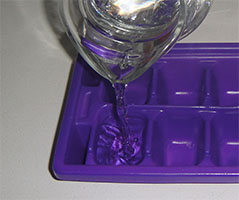
Take the case of Water. This substance, whose chemical formula is H2OWhen in a liquid state, it is clearly amorphous: it adapts to the shape of the container that contains it. The water can be stored in a rectangular, round or triangular container, to name a few possibilities.
When water solidifies and becomes ice, takes the shape of the container. If we put water in a cooler (also known as ice bucket) and we leave it for a few hours in a freezer, the resulting pieces of ice will adopt the cubic shape of each of the small compartments, and hence they are known in everyday speech as ice cubes.
The amoebas, on the other hand, they are amorphous microorganisms. This unicellular protist does not have cell walls, a peculiarity that causes its shape to change constantly and is not stable.
The dictionary produced by the Royal Spanish Academy (RAE) also mentions that the amorphous adjective can be applied to the person who it has no character of its ownRather, their behavior and thoughts are influenced by interference from others. This relates to the scope of characterology, a methodical knowledge of the human being that allows us to distinguish each one from the others based on those traits that make them original.
The study of characterology has various applications, such as the investigation of criminal acts. When this knowledge is applied to the field of criminology, it is possible to accelerate and direct a process, through meticulous observation of the criminal's actions in order to understand their character and thus anticipate their plans. It should be mentioned that characterology also serves to understand the behavior of groups of people who share interests or behavioral traits.
The characterology, therefore, allows to establish a classification of the different types of characters that a human being can have. According to the French psychologist and philosopher René Le Senne, author of the philosophy existential ideo, we can distinguish eight profiles of character, which are the following: nervous, passionate, choleric, sentimental, sanguine, phlegmatic, apathetic and amorphous.
Returning to this last type of character, we can say that its most outstanding feature is the laziness, which is presented in a deep and rooted way. It is about those people who do not spend part of their time reflecting on the future or the consequences that their actions may have, but instead live in the present and focus on meeting their needs with the least possible effort.
Amorphous individuals have great difficulty in refusing to influence of others, and this can lead them to commit acts of various natures; In a kidnapping case, for example, this personality is common in the person designated to hold the victim and take care of bringing him food.
Usually amorphous are large procrastinatorsas they postpone their obligations until the last minute. Similarly, they avoid overly demanding tasks by all means and seek to take advantage of the effort of others. As if this were not enough, they sleep too much and have no practical sense.
Leave a Reply