
alkynes
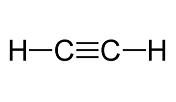
To understand what are alkynes, we must know what is the meaning of the notion of hydrocarbon. This concept refers to the chemical compound that arises when carbon combines with hydrogen.
Within the group of hydrocarbons, we can mention hydrocarbons aliphatic, whose main characteristic is that lack aromaticity (A property that leads the electrons present in the double bonds to circulate freely between the bonds, giving the molecule greater stability compared to what happens when the electrons remain fixed).
From these ideas, we can say that alkynes are hydrocarbons of the aliphatic type (that is, non-aromatic) that have one or more triple bonds between two carbon atoms. The high energy of the triple bond gives them metastability, since they have different states of equilibrium and tend, in the face of external actions, to evolve towards a condition of a strong balance.
Alkynes usually participate in chemical reactions addition, such as hydration, halogenation, and hydrogenation. These hydrocarbons, on the other hand, have less density than water, a substance in which they are not soluble. Another physical characteristic of alkynes indicates that, when the molecular weight increases, the boiling and melting points also increase and the density.
In addition to all the above, it is worth knowing another important series of unique data on alkynes such as these:
-When making their nomenclature, we can underline that they respond to what is the formula CnH2n-2. That without forgetting that what is done in them is to come to replace the suffix "-ano" of the "alk-ano" with the same number of what are carbons by the suffix "-ino". Thus, for example, instead of propane there is propyne and instead of ethane there is ethyne.
-They are more polar than alkenes or alkanes can be.
-It must be emphasized that, although there are different procedures that can be carried out with these hydrocarbons in question, there are some that are especially significant. Among these is, above all, the one that responds to the name of dehydrohalogenation of neighborhood dihaloalkanes.
-From alkynes and through the corresponding process, what is called acetylides can be formed.
-When you want to undertake what is the hydrogenation of alkynes in alkanes, it must be established that a procedure is undertaken in which what is called alkene plays a leading role.
-In liquid ammonia and sodium, the aforementioned hydrogenation can also be undertaken.
-Other actions that are also carried out having alkynes as fundamental axes are, among others, hydroboration and hydration without forgetting what is called halogenation.
The ethyne, also called acetylene, is an example of alkyne. East gas, which is the simplest alkyne, has one of the highest combustion temperatures known and is used as a source of heat and light.
Leave a Reply