
alert
The term alert, from Italian all'erta, refers to a surveillance situation or attention. A condition or one warning sign it's a notice so that precautions are taken or increased vigilance.
Similarly, someone who is alert is a person that is attentive to certain questions. For example: "You have to be alert to the players who attack in your sector, as they can hurt us", "Juan must be alert and not be distracted to prevent thieves from entering the property". In the same sense it is used to speak of an animal that is prepared to hunt another, stalking its prey to be able to catch it at the precise moment. On the other hand, it can also refer to the animal that feels that another is chasing or stalking it, it puts itself in an alert attitude to be able to escape as quickly as possible as soon as it has a clear notion of danger.
Alert can also be the run up to a planned disaster. In the face of an imminent attack or an upcoming meteorological phenomenon, the authorities have the possibility to establish different driving states so that people act accordingly. There is a pre-alert, alert and alarm state, which is decreed when the disaster is already occurring.
In this sense, an alert is issued to warn the population that danger is approaching, in such a way that it can protect itself or go to fulfill its obligations in case of emergency.
Finally, it should be noted that Alert is a Peruvian town in the province of Purús (Ucayali region), a spanish newspaper founded in 1937 and a Venezuelan television program dedicated to journalistic investigation.
Colors in weather alerts
A weather alert It is one that indicates that a climatic phenomenon is approaching that can be dangerous (a strong storm, a hurricane, etc.). Generally, these alerts ask people not to leave their homes and to take shelter.
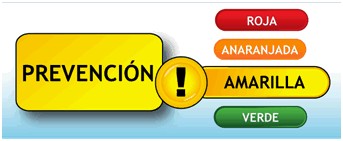
As determined by the European criterion of climatology, the way in which the degrees of severity of each meteorological situation can be distinguished are green, yellow, orange and red.
These colors would warn the population about possible rain, snow, winds or high temperatures and would allow them to prevent the consequences dramatic events of these situations.
Green color: indicates that there is no risk, so citizens can rest easy, without fear of anything happening.
Yellow color: This color indicates that there is a danger or threat in a specific place.
Orange: it takes place very few times during the year and warns of important damages that may affect a group of the population; In general, these damages are irreversible, but in some cases there are possible solutions, although after a large investment of money, time and work.
Red color: indicates that there is a catastrophic danger that will affect a large part of the population and will have important consequences on life and its infrastructure. It takes place once every many years and it is important to be extremely vigilant to prevent its consequences.
According to the type of alert that is issued by the meteorological system of the place, the public will be able to know what type of weather awaits them: if there will be rains, snowfalls, winds, cyclones, tsunamis or the temperature will rise sharply and you will therefore be able to make a decision about your own activities to prevent climate change from affecting your health.
To issue a weather alert the meteorologic service receives a series of signals through different tools arranged in the environment to emit them, and can alert the population to protect themselves from a certain catastrophe caused by a sudden climate change.
Leave a Reply