
Abrogation

The abrogation is the total annulment of a written law by means of an express and formal act indicating that said annulled law remains without effect.
Abrogation renders the entirety of a legal norm worthless, it is an act that does not annul parts of a law, but is only used to annul the totality of the norm.
Although a characteristic of the abrogation is the need for a solmene act that annuls the law, there is a tacit abrogation option, that is, without this solemn act.
Types of abrogation
As for the classes, we can find two main types of abrogation:
- La tacit abrogation It is one that occurs when the law is totally incompatible with a new subsequent legal system and must be completely annulled.
- Express repeal It is the most common and it is carried out by a formal act, nullifying the law completely. This is common in the United States where the court can repeal a law issued by Congress when it is contrary to the constitution. These same powers can be observed in countries such as Spain, Cuba and Mexico.
The abrogation nullifies the whole of a law, which means that it invalidates that normative body. That is, it is not that it is no longer valid, but that it is null.
Not only completely annuls a law, but any other normative body, regulation, decree-law, a precept or a complete code.
There is another figure that could lead to confusion with abrogation and that is the repeal. In fact, already in Roman law these two different concepts appeared. We are going to analyze the differences.
Differences between repeal and repeal
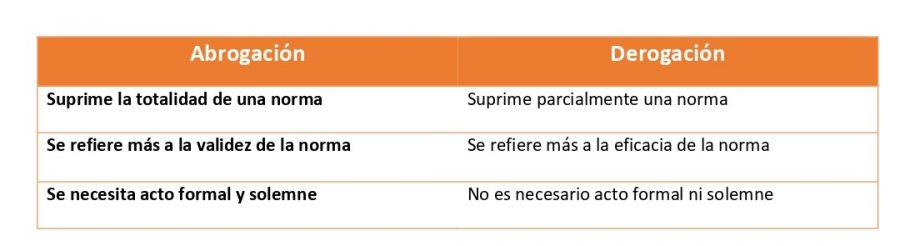
The main differences between repeal and repeal can be seen summarized in the following table:
Leave a Reply