
Why do warts appear on my neck?
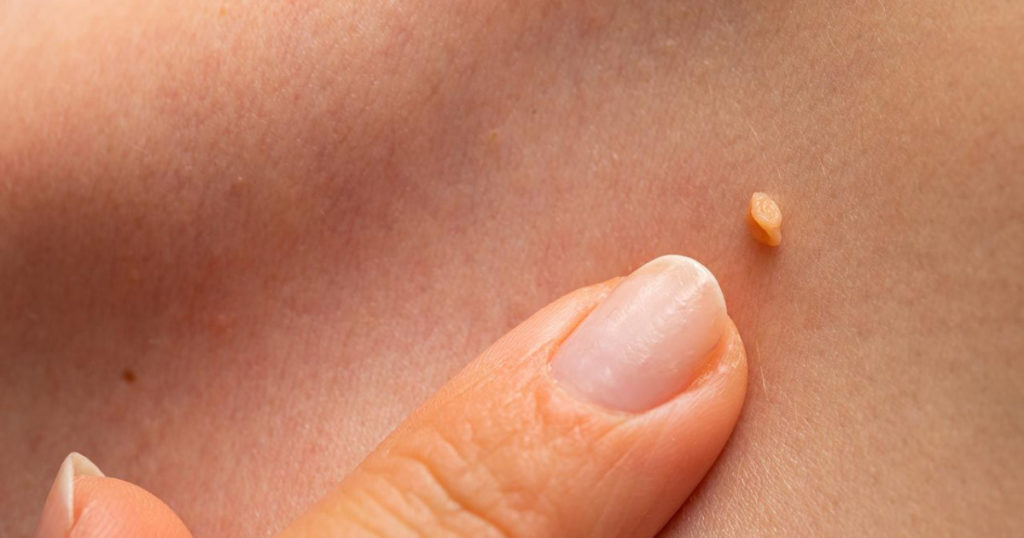
The neck is, at the level of human relationships, one of the most exposed parts of our body and one of the first we see when we are talking with another person. Hence, everything that may affect its aesthetics is a cause for concern. And in this context, warts that develop on the neck are something that worries many people.
Warts are small bumps on the skin that look like lesions and can develop anywhere on the body. Although they are not dangerous to health or tend to cause pain, they are uncomfortable, annoying and unsightly, depending on the consistency of the wart and, above all, on the dermatological region where they develop.
In this sense, warts on the neck are one of the most worrisome. Due to their relative high frequency, the fact that they can cause secondary injuries if rubbed or caught and, of course, their aesthetic impact, it is important to know why these bumps appear on the skin of the neck.
Thus, in today's article and in the hands of the most prestigious scientific publications, we are going to analyze the clinical bases of warts that develop specifically on the neck, looking at the main causes behind its appearance and analyzing treatment options for them. Let us begin.
What are warts?
Warts are small bumps, granular bumps that develop on the skin anywhere on the body as a result of an infection by the Human Papilloma Virus (HPV).. These are injuries that, although they are not dangerous or usually cause pain, they are unsightly, annoying and uncomfortable.
Now, although warts as such are these rough lesions to the touch with a pattern of black dots (due to small blood vessels of clotted blood), there are other lesions that can arise in the neck and that are not due to a viral infection like warts and that are also soft and flesh-colored or brown, which are known as fibroids. These tend to appear in skin folds, groin, armpits and, of course, neck.
Continuing with these fibroids, these are also known as skin tags or seborrheic keratosis. In this sense, fibroids are benign tumors that arise from abnormal and accelerated growth of our skin cells but that, unlike warts as such, are not contagious.
Fibroids in the neck are painless in the vast majority of cases and beyond specific episodes of inflammation, they do not tend to be bothersome. But taking into account that, appearing between 25 and 30 years old, they can measure between 0.5 and 1 cm and grow both in size and number, the aesthetic impact can be noticeable.
Either way, the important thing is that neither fibroids nor warts can be treated with home remedies. The visit to the dermatologist is mandatory, as this professional will determine if it is one injury or another and, depending on their characteristics, will apply one treatment or another. It should be noted that the interventions to eliminate warts and fibroids are, today, fast, safe and effective.
Treatment options will be discussed later, but they consist of the use of lasers, cryotherapy, electrosurgery, use of salicylic acid and, in some cases, surgery. The important thing is that warts, which also often disappear on their own after a few weeks or months without the need to intervene, can be easily removed.
Fibroids and warts on the neck: why do they appear?
As we have seen, fibroids and warts are not the same, although we often confuse them. Warts are contagious; fibroids, no. Thus, we must differentiate between the two if we are going to talk about the causes behind the appearance of these unsightly growths on the neck.
Let's start with warts. Warts are so frequent because we are facing an infectious dermatological disease that can be transmitted between people by contagion of the Human Papilloma Virus (HPV), of which there are more than 150 subtypes and some of them cause the development of warts by direct or indirect contact with objects that a person with warts has touched.
Depending on the area where the virus has been contacted, the wart will grow in one part or another of the body. It must be taken into account, however, not only that generally there must be wounds that allow the pathogen to enter, but that many times the person's own immune system fights the contagion before the wart develops.
It is for this reason that, although they can appear at any time in life, warts tend to appear in people with less mature immune systems (the child population) or in people with weak immune systems. In this sense, although exposure and infection to the Human Papilloma Virus (HPV) is the trigger, there are important factors that come into play: immune status, genetic predisposition, hormonal changes, wounds on the skin of the neck, etc.
Having seen warts, let's now talk about fibroids. The key in them is that they are not contagious, because its appearance is not due to an infection by the Human Papilloma Virus (HPV). Thus, they are developed by purely genetic triggers and hormonal risk factors (they are associated with poorly controlled diabetes) and being overweight.
Fibroids can be confused with warts, but unlike these, they are soft (warts are rough) and appear in the folds of the neck, generally grouped and arising between 25-30 years. As we have said, fibroids or skin tags are benign tumors that, while not dangerous, are unsightly like warts.
How are warts and fibroids on the neck treated?
For the treatment of both warts and fibroids, it is best to put ourselves in the hands of a dermatologist. Not only to treat these injuries themselves, but to differentiate between whether we are dealing with a case of wart or one of fibroma, since the treatment to choose will be different in each case. So we have to differentiate between the two protrusions again.
Let's start with warts. As a rule, warts on the neck go away on their own without the need for treatment as the viral infection by the Human Papilloma Virus is being fought by the body. 30% of warts disappear before six months (some remit for weeks); while another 40% do so after two years. Even so, it is true that there is a significant percentage (another 30%) in which this does not happen. In this case, especially if they grow or cause discomfort, it is important to intervene on the problem.
Obviously, home remedies to remove warts should not be applied under any circumstances. We are not even going to mention them. Not only because they can leave scars for life (even more unsightly than the wart itself), but because there is a risk of infection that, in some cases, can be complicated.
We must always go to a dermatologist. Treatments to remove warts are quick (in about 15 minutes everything is ready), painless, effective and safe, because practically without risk of scarring or infection. Depending on the nature of the wart and the exact location, one treatment or another will be chosen.
Alternatives include: CO2 laser (the laser evaporates the wart practically without leaving marks, thus being the most effective method), salicylic acid (applied topically and later the wart is filed to remove dead skin), cryotherapy (it is applies liquid nitrogen on the wart, but in the neck there is a risk of scarring and it is painful), electrosurgery (the wart is burned without leaving a scar) and, in case none of these are viable, surgery can be chosen, in the that, obviously, there is a small scar left in the area.
After any of these interventions, it is important to hydrate the skin (after leaving the consultation, apply moisturizing creams on the skin and drink plenty of water), follow up with the dermatologist to evaluate how the skin is evolving and avoid sun exposure as far as possible; and if it is not feasible, apply sunscreen whether it is winter or summer.
Lastly, let's talk about fibroids. As we have said, unlike warts, they are neither contagious nor can they be spread by contact. They are benign tumors that are not due to a viral infection. The approach by the dermatologist will be different, but the treatment alternatives are very similar: laser therapy, cryotherapy, electrocoagulation (an electrical current is used to coagulate the tissues that we are going to remove) and, if none is viable, surgery .
In this case of fibroids, treatment becomes even more important. Not because they are dangerous or painful, but because unlike warts, being benign tumors, they do not disappear on their own. Moreover, without intervention, they grow in size and number. So, if they are bothering you or bothering you aesthetically, it's time to visit the dermatologist. A few minutes of minimally invasive treatment and everything is solved.
Leave a Reply