
abbreviation
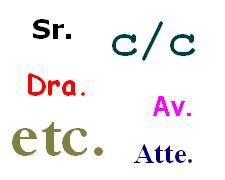
The term abbreviation has its origin in the Latin language, and it is an orthographic procedure that involves the one word reduction through the deletion of trailing or central letters and that, generally, ends with a point. Some examples are: Atte. (for "Sincerely"), Mr. (for "Mister"), Dr. (for "doctor").
Although the aforementioned abbreviations (and many others) are widely used and have acquired a conventional form, any person Anyone who can write can create an abbreviation for their personal use. When a writer does this, they usually include a glossary at the beginning or end of your work where you explain the particular abbreviations you have used.
There are two ways to abbreviate a term: by truncation or by contraction. The abbreviation for truncation consists of eliminating the part final of the word, as can be seen by observing Av. (for "avenue"), O well etc. (for "etc"). In the Spanish language, this type of abbreviation never ends in a vowel, unlike other languages, such as English (see Bird., which corresponds to the term Avenue, what does it mean avenue).
This leads us to try a error It is very common for students of foreign languages, or those who consider that they can speak a language simply because it has certain superficial similarities with theirs: transferring the spelling rules from their native language to the foreign one. Both the punctuation and the division of the words, the accentuation, the grammar and of course the abbreviations can vary substantially from one language to another, and it is essential to take this into account in order to learn correctly.
The most usual thing, regardless of the construction of the abbreviation itself, is that it is assumed that all have a full stop. If we take "doctor" as an example, one of the most commonly abbreviated terms in several idiom, it is very likely that many people believe the abbreviation is correct Dr. in any Romance language, among which are Spanish, Portuguese, Italian and French, among many others. In the same way, given that the Anglo-Saxon term "doctor" is widely known and that it has the same spelling as its corresponding Spanish, it is surely also considered natural that is abbreviated as in Castilian.
Using this last case in particular, if we refer to the English rules to build abbreviations, we will notice that if its last letter corresponds to the last letter of the original term, then it should not end with a period. This makes it clear that the Castilian "Dr." and the English "Dr" there is a difference, however small it may seem, and that they should not be used interchangeably.

The abbreviation for contraction, on the other hand, supposes the elimination of the central letters of the word, leaving only the most representative; some of the most used are Avda. (for "avenue") Y . (for "number").
There are abbreviations that can end in flown letters, such as no. (for "number"). On the other hand, there are abbreviations in which the end point of a word is replaced by a bar inclined: DC (for "current account") or each (for "each"). There are even abbreviations that can be written in parentheses: (to) (for "alias").
It should be noted that, according to the spelling rule, abbreviations should keep the accent mark of the source word, as with P. (for "page").
The acronym and acronym are other types of abbreviations and are often confused with each other and with abbreviations, although in essence they are clearly different: initials consists of taking the initial letter of each word that makes up a expression complex type, as is the case of GDP (Gross Domestic Product); the acronymInstead, it uses more letters of the terms it combines, so that its sound is equivalent to that of a word, as is the case with MERCOSUR (Southern Common Market).
Leave a Reply