
gesture
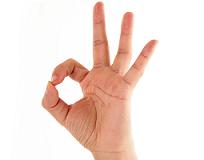
Gesture It is a concept with a very interesting etymological origin. The term comes from a classical Arabic word that referred to a legal guarantee. When a person tried to replace said warranty, appealed to promises or oaths accompanied by bombastic gestures. In this way, the sense of gesture was changing until it was associated with the movements an individual makes to convey a message or convey something.
For example: "The old man made a gesture with his hand to indicate to the young man not to continue speaking", "In the stadium nobody understood the gesture that the footballer made after scoring the goal", "A dog must learn to interpret the gestures of his master ".
Take the case of a person you want to take a cab. For this, you will stand on the curb to wait for one of these vehicles to approach. When you detect that a taxi is coming, you must make a wave with the hand to signal the driver to stop as you want to get on. The gesture is usually to extend the arm with the open hand.
In this context, we can also use the word sign to refer to a gesture with which a person intends to imply something in particular, generally performed with one or both hands. It is important to clarify that in each Spanish-speaking country there are different uses for these and other terms, such as gesture, which usually speaks of a position characteristic of the eyebrows and lips, among other parts of the face, although it can also describe an action with the hands or legs.
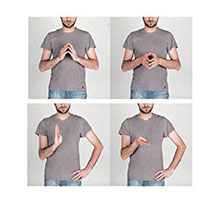
The gestures are not universal, but are inextricably connected to a culture; For this reason, when we travel to a foreign country we must avoid communicating through this language, until learning the local gestures and the meaning that ours have there. There are plenty of stories of embarrassing situations in which a tourist makes a gesture that in his hometown denotes gratitude or joy, but that for the locals has a rude or obscene connotation.
When used in the plural, the term gesture is used to refer to the manners of a person, that is, to all those actions that he uses to be noticed and distinguished from those around you, demonstrating your level of education. In this way, just as we can talk about someone's good or bad manners, it is also possible to describe their gestures as rude or outgoing, for example. It is important to clarify, however, that this use is not very common in everyday speech, but is especially found in the written language.
A gesture, on the other hand, may be a body posture or one action reflecting a mood, a emotion or one intention. Suppose a police officer intercepts a man who was walking suspiciously, with his face covered. This man first stops at the agent's call but, while the policeman asks him some questions, he makes a gesture to escape, turning the body sharply. So the policeman decides to stop him and immobilize him to prevent him from fleeing.
As can be seen in the previous example, this use of gesture serves to describe an action that does not materialize: the suspicious man tries to escape, but the police officer stops him in time, preventing him from complying with his objective. We do not very often find the term gesture with this meaning in everyday speech; to express this type of situation it is more frequent to use the verb hit: "The man managed to escape, but the policeman caught him before he could start running".
Leave a Reply