
aqueduct
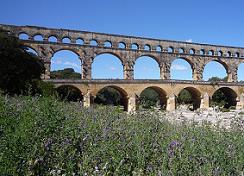
In order to understand the meaning of the term aqueduct we have to start by establishing its etymological origin. In this case, we can determine that it derives from Latin, from “aquaeductus”, which is the result of the sum of two components:
-The noun “aqua”, which is synonymous with “water”.
- “Ducto”, which derives from the verb “ducere”, which is equivalent to “guide”.
It's about a channel artificially constructed to carry the Water to a specific site. This type of system allows water to flow from the space where it is found naturally to a different place, where it is used by people.
In ancient times, the towns used to settle next to the rivers so that the transfer of the water to the houses was easy. Wells were also dug to access this resource. However, as the settlements grew, it became necessary to implement a mechanism to direct the water towards the surroundings. In this way the first aqueducts arose.
Certain eastern peoples and the Greeks developed the primitive aqueducts, although the romans they were the ones who most promoted this system through new techniques and the use of concrete (concrete) in the construction.
The aqueducts of the Romans consisted of channels built on mountainous slopes, with a slight incline. They also had coffers or boxes that allowed the settling of the solid objects that the water dragged and the regulation of the flow.
These aqueducts, on the other hand, appealed to siphons Y bridges to avoid obstacles and slopes. Some of these bridges were also used for the circulation of people and carriages.
The Aqueduct of Segovia, created in the 2nd century, is an example of these Roman aqueducts. Stretched across fifteen kilometers, from the spring of a mountain range to the city. Today this aqueduct is part of the World Heritage of the UNESCO.
In addition to all the above, we have to highlight another series of aspects of this important monument in Castilla y León, such as the following:
-The best area to be able to enjoy it and admire it in situ is from the well-known Plaza del Azoguejo.
-It has the particularity that it was built using granite ashlars and without any type of mortar being used between them.
-In the upper part of the Aqueduct of Segovia there are two niches. During the time of the Catholic Monarchs, some carvings of San Sebastián and the Virgen de la Fuencisla were established there. The latter is precisely the only one of the two that is preserved today.
-Around this construction there is a legend about its origin. Specifically, it is established that a girl, tired of having to carry water continuously, asked the demon to do something. He accepted the deal stating that if he gave her a solution before the rooster crowed, she would give him her soul. Fortunately when that animal sang, the devil still had a stone to place in the aqueduct, so the youngest got rid of the bet.
Leave a Reply