
watercolor

The etymology of watercolor leads us to acquarella, a word from the Italian language. A watercolor is a painting that is reflected on a paperboard or a paper, whose colors are diluted in Water. The concept also makes it possible to refer to colors used in this type of paintings and this type of artistic technique in general.
Historians believe that watercolor arose a century before Christ in China, when the role began to unfold. The Arabs, during the XII century, led the production of paper from Asia to Europe and so with the weather, the watercolor is installed in the Old continent. Thus, among European artists, the watercolor technique succeeded the fresco. The German Albrecht dürer and italian Raffaello Santi they were some of the pioneers of watercolor in that region.
Watercolor paints are made with different pigments that bind, usually with gum arabic. Water is a very important component in this technique since, according to the amount used, more or less transparent colors are obtained. The type of paper also affects the result of the work. Artists often choose paper according to texture and tension, keeping in mind their work plan.
For its part, gum arabic is a sticky and amorphous substance that certain plants exude and that becomes hard when it comes into contact with the air. Although it is not soluble in alcohol, it is soluble in water, and it is used as a thickener in the pharmaceutical and gastronomic industries. In the case of the kitchen, it is ideal to give elasticity to certain dishes and desserts, such as marzipan and jelly beans, although it also serves to give the texture suitable for certain beverages.
The watercolor is based on the washes that the artist applies. With a cloth, a sponge or a brush, it is possible to add or remove water, achieving greater or lesser transparency. Sometimes, a great transparency of the paint is sought so that the paper provide the luminosity.
Tips to start painting with watercolor
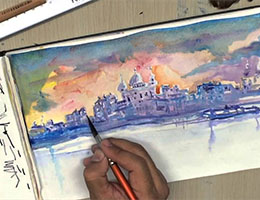
Watercolor is a material especially versatile, and this can lead to the first experience being very rewarding or very frustrating, since it all depends on the objectives we set ourselves and the way in which we approach the technique.
One tip that teachers often give their students is not to think so much about the results they want to achieve, but let go and enjoy every step; furthermore, we should never pretend to make a masterpiece right off the bat. That is why it is important to be patient and face learning with perseverance, knowing in advance that it will take us many trials to get a satisfactory product.
Regarding the medium, it is recommended to use a sheet of paper of considerable thickness. The first step is to make a sketch with a pencil, without pressing too much, so that it is possible to make as many corrections as we want. As mentioned in the previous paragraph, we must not seek perfection or aim for a high degree of complexity: few elements, simple and shocking, It is a good starting point.
Once we have the pencil design ready, it is time to prepare and apply the watercolor. Ideally, place a small amount on the palette, slightly moisten the Brush and dilute the paint with a few droplets of water, until it reaches the appropriate thickness for handling. Throughout the process, we will have to let the sheet dry, to be able to work in several layers, among other things.
Leave a Reply