
asymmetry

There are concepts that are only understood by opposition: asymmetry It is one of them. The dictionaries define this term as the lack of symmetry or the opposite of it. It is essential, therefore, to know what symmetry is to understand the idea of asymmetry.
With origin in Latin symmetria and more remote antecedents in the Greek language, symmetry is the quality that refers to correspondence in terms of the dimensions, shapes and locations of the various components that make up a whole. Symmetry can also be considered with respect to a flat or one position.
When such correspondence does not exist, we speak of asymmetry. In other words: what is not symmetrical is asymmetric. At a general level, it can be said that symmetry is associated with beauty, so that what has asymmetry is not beautiful or is dissonant in its disharmony.
This idea of symmetry as a synonym for beauty applies to both living beings and sculptures and, in general, to any creation of man or element of nature. For example, many people tend to chase designs of devices such as televisions or mobile phones that exhibit a symmetrical appearance, as opposed to that of old tube televisions (with the screen on one side and controls on the other) and rotary telephones (with the cable that connected the receiver to the base hanging to one side of the device).
However, not everyone considers asymmetry as a negative trait; on the contrary, in all areas there are many people who appreciate the quality of unique that an asymmetric arrangement of the traits or of the forms it can print on a living being or on any natural or artificial object. In this same line of thought, symmetry is associated with the artificial, with something that has no life, such as a mannequin, and is not valued positively in a sculpture, since it represents a human being taking into account its plane emotional.
Statistical asymmetry
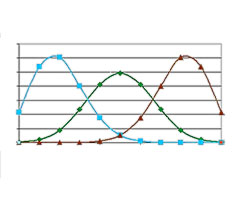
The indicators thanks to which it is possible to identify the degree of symmetry or asymmetry present in a probability distribution (a function that assigns to a series of certain events the probability occur) of a random variable (also known as stochastic variable, is a function that assigns events to real numbers) without the need to represent it graphically are called asymmetry measures.
In this context, taking as a reference the axis that passes through the mean of said distribution, the line parallel to said axis is called the axis of symmetry. When the amount of values it is equal to both sides (to the right and to the left), the distribution is said to be symmetric; in this case, the number of positive and negative deviations also coincide.
The asymmetry to the right, also called negative skew, occurs when the number of values to the right of the mean is greater than the negative ones (which are to the left); This can also be expressed by saying that the tail is longer on that side of the half. The opposite case is called asymmetry to the left or negative.
A concept related to asymmetry within the field of statistics is the kurtosis, also called pointing. It is the level of acuity or flattening that presents a probability distribution with respect to the normal one; In other words, it is the measurement used to determine how sharp your appearance. The three types of possible kurtosis allow us to speak of distributions leptokurtic, mesocúrticas Y platicúrticas, depending on the concentration is high, normal or low, respectively.
Leave a Reply