
Law of supply and demand

What is the law of supply and demand?
The law of supply and demand It is a principle by which the market economy is based and sustained (free competition). This explains the relationship that exists between the market supply of a good or service and its market demand, by consumers.
The law states that within a market of perfect competition, will seek a point of equilibrium between supply and demand, a point at which consumers are willing to buy and producers also make a profit.
From the law of supply and demand, in turn, two individual laws arise:
- Law of supply: the quantity supplied of a product or service is directly related to its price. The higher the price, the higher the quantity supplied. The lower the price, the lower the quantity supplied.
- Demand law: the quantity demanded by consumers is directly related to the price of the product or service. The lower the price, the higher the quantity demanded. The higher the price, the lower the quantity demanded.
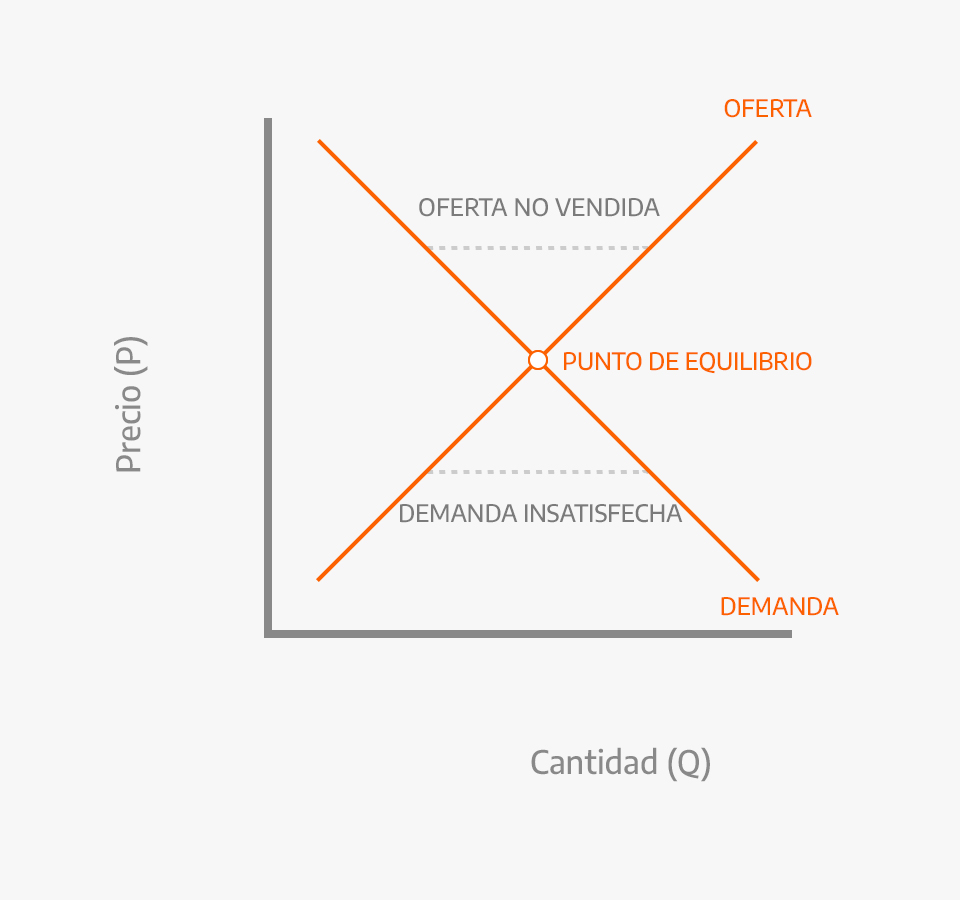
Graph of the law of supply and demand.
Examples of the law of supply and demand
Here are 2 examples to better understand the law of supply and demand.
Offer
Suppose that in a cake and beverage business, the salesperson realizes that you are selling much more than you have produced (quantity supplied). So the next day make more cakes and buy more drinks to satisfy the consumer (customer).
In the same way, the seller might find that he is not selling much. In this case you could make a promotion of your cakes or change the price of these, to sell more.
Demand
Suppose the owner of a supermarket realizes that a certain Product has not been sold, so you decide to price it much lower, even though it may not suit you.
This is because if the consumer sees a lower price, they will tend to buy moreIn the same way that if you see a very high price, you will tend to buy less.
Leave a Reply